Meshes, Variables and Materials
If you are interested in learning how to deal with these objects in parallel, See Multi-Block Objects and Parallel I/O.
This section of the Silo API manual describes all the high-level Silo objects that are sufficiently self-describing as to be easily shared between a variety of applications.
Silo supports a variety of mesh types including simple 1D curves, structured meshes including block-structured Adaptive Mesh Refinement (AMR) meshes, point (or gridless) meshes consisting entirely of points, unstructured meshes consisting of the standard zoo of element types, fully arbitrary polyhedral meshes and Constructive Solid Geometry meshes described by boolean operations of primitive quadric surfaces.
In addition, Silo supports both piecewise constant (e.g. zone-centered) and piecewise-linear (e.g. node-centered) variables (e.g. fields) defined on these meshes. Silo also supports the decomposition of these meshes into materials (and material species) including cases where multiple materials are mixing within a single mesh element. Finally, Silo also supports the specification of expressions representing derived variables.
DBPutCurve()
Summary: Write a curve object into a Silo file
C Signature:
int DBPutCurve (DBfile *dbfile, char const *curvename,
    void const *xvals, void const *yvals, int datatype,
    int npoints, DBoptlist const *optlist)
Fortran Signature:
integer function dbputcurve(dbid, curvename, lcurvename, xvals,
   yvals, datatype, npoints, optlist_id, status)
Arguments:
Arg name
Description
dbfileDatabase file pointer
curvenameName of the curve object
xvalsArray of length
npointscontaining the x-axis data values. Must beNULLwhen eitherDBOPT_XVARNAMEorDBOPT_REFERENCEis used.yvalsArray of length
npointscontaining the y-axis data values. Must beNULLwhen eitherDBOPT_YVARNAMEorDBOPT_REFERENCEis used.datatypeData type of the
xvalsandyvalsarrays. One of the predefined Silo types.npointsThe number of points in the curve
optlistPointer to an option list structure containing additional information to be included in the compound array object written into the Silo file. Use
NULLis there are no options.Returned value:
DBPutCurvereturns zero on success and -1 on failure.Description:
The
DBPutCurvefunction writes a curve object into a Silo file. A curve is a set of x/y points that describes a two-dimensional curve.Both the
xvalsandyvalsarrays must have the samedatatype.The following table describes the options accepted by this function. See the section titled “Using the Silo Option Parameter” for details on the use of this construct.
Optlist options:
Option Name
Value Data Type
Option Meaning
Default Value
DBOPT_LABELintProblem cycle value
0DBOPT_XLABELchar *Label for the x-axis
NULLDBOPT_YLABELchar *Label for the y-axis
NULLDBOPT_XUNITSchar *Character string defining the units for the x-axis
NULLDBOPT_YUNITSchar *Character string defining the units for the y-axis
NULLDBOPT_XVARNAMEchar *Name of the domain (x) variable. This is the problem variable name, not the code variable name passed into the
xvalsargument.NULLDBOPT_YVARNAMEchar *Name of the domain (y) variable. This is problem variable name, not the code variable name passed into the
yvalsargument.NULLDBOPT_REFERENCEchar *Name of the real curve object this object references. The name can take the form of
"<file:/path-to-curve-object>"just as mesh names in theDBPutMultiMeshcall. Note also that if this option is set, then the caller must passNULLfor bothxvalsandyvalsarguments but must also pass valid information for all other object attributes including not onlynpointsanddatatypebut also any options.NULLDBOPT_HIDE_FROM_GUIintSpecify a non-zero value if you do not want this object to appear in menus of downstream tools
0DBOPT_COORDSYSintCoordinate system. One of:
DB_CARTESIANorDB_SPHERICALDB_CARTESIANDBOPT_MISSING_VALUEdoubleSpecify a numerical value that is intended to represent “missing values” in the x or y data arrays
DB_MISSING_VALUE_NOT_SETIn some cases, particularly when writing multi-part silo files from parallel clients, it is convenient to write curve data to something other than the “master” or “root” file. However, for a visualization tool to become aware of such objects, the tool is then required to traverse all objects in all the files of a multi-part file to find such objects. The
DBOPT_REFERENCEoption helps address this issue by permitting the writer to create knowledge of a curve object in the “master” or “root” file but put the actual curve object (the referenced object) wherever is most convenient. This output option would be useful for other Silo objects, meshes and variables, as well. However, it is currently only available for curve objects.
DBGetCurve()
Summary: Read a curve from a Silo database.
C Signature:
DBcurve *DBGetCurve (DBfile *dbfile, char const *curvename)
Fortran Signature:
integer function dbgetcurve(dbid, curvename, lcurvename, maxpts,
   xvals, yvals, datatype, npts)
Arguments:
Arg name
Description
dbfileDatabase file pointer.
curvenameName of the curve to read.
Returned value:
Returns a pointer to a
DBcurvestructure on success andNULLon failure.Description:
The
DBGetCurvefunction allocates aDBcurvedata structure, reads a curve from the Silo database, and returns a pointer to that structure. If an error occurs,NULLis returned.
DBPutPointmesh()
Summary: Write a point mesh object into a Silo file.
C Signature:
int DBPutPointmesh (DBfile *dbfile, char const *name, int ndims,
    void const * const coords[], int nels,
    int datatype, DBoptlist const *optlist)
Fortran Signature:
integer function dbputpm(dbid, name, lname, ndims,
   x, y, z, nels, datatype, optlist_id,
   status)

void* x, y, z (if ndims<3, z=0 ok, if ndims<2, y=0 ok)
Arguments:
Arg name
Description
dbfileDatabase file pointer.
nameName of the mesh.
ndimsNumber of dimensions.
coordsArray of length
ndimscontaining pointers to coordinate arrays.nelsNumber of elements (points) in mesh.
datatypeDatatype of the coordinate arrays. One of the predefined Silo data types.
optlistPointer to an option list structure containing additional information to be included in the mesh object written into the Silo file. Typically, this argument is
NULL.Returned value:
Returns zero on success and -1 on failure.
Description:
The
DBPutPointmeshfunction accepts pointers to the coordinate arrays and is responsible for writing the mesh into a point-mesh object in the Silo file.A Silo point-mesh object contains all necessary information for describing a point mesh. This includes the coordinate arrays, the number of dimensions (1,2,3,…) and the number of points.
The following table describes the options accepted by this function. See the section about Options Lists for details on the use of the
DBoptlistconstruct.Optlist options:
Option Name
Data Type
Option Meaning
Default Value
DBOPT_CYCLEintProblem cycle value.
0
DBOPT_TIMEfloatProblem time value.
0.0
DBOPT_DTIMEdoubleProblem time value.
0.0
DBOPT_XLABELchar*Character string defining the label associated with the X dimension.
NULLDBOPT_YLABELchar*Character string defining the label associated with the Y dimension.
NULLDBOPT_ZLABELchar*Character string defining the label associated with the Z dimension.
NULLDBOPT_NSPACEintNumber of spatial dimensions used by this mesh.
ndims
DBOPT_ORIGINintOrigin for arrays. Zero or one.
0
DBOPT_XUNITSchar*Character string defining the units associated with the X dimension.
NULLDBOPT_YUNITSchar*Character string defining the units associated with the Y dimension.
NULLDBOPT_ZUNITSchar*Character string defining the units associated with the Z dimension.
NULLDBOPT_HIDE_FROM_GUIintSpecify a non-zero value if you do not want this object to appear in menus of downstream tools
0
DBOPT_MRGTREE_NAMEchar*Name of the mesh region grouping tree to be associated with this mesh.
NULLDBOPT_NODENUMvoid*An array of length nnodes giving a global node number for each node in the mesh. By default, this array is treated as type int.
NULLDBOPT_LLONGNZNUMintIndicates that the array passed for
DBOPT_NODENUMoption is of long long type instead of int.0
DBOPT_LO_OFFSETintZero-origin index of first non-ghost node. All points in the mesh before this one are considered ghost.
0
DBOPT_HI_OFFSETintZero-origin index of last non-ghost node. All points in the mesh after this one are considered ghost.
nels-1
DBOPT_GHOST_NODE_LABELSchar*Optional array of char values indicating the ghost labeling (
DB_GHOSTTYPE_NOGHOSTorDB_GHOSTTYPE_INTDUP) of each pointNULLDBOPT_ALT_NODENUM_VARSchar**A null terminated list of names of optional array(s) or
DBpointvarobjects indicating (multiple) alternative numbering(s) for nodes.NULLThe following
optlistoptions have been deprecated. Instead use MRG treesDBOPT_GROUPNUM|int|The group number to which this pointmesh belongs.|-1 (not in a group)
DBGetPointmesh()
Summary: Read a point mesh from a Silo database.
C Signature:
DBpointmesh *DBGetPointmesh (DBfile *dbfile, char const *meshname)
Arguments:
Arg name
Description
dbfileDatabase file pointer.
meshnameName of the mesh.
Returned value:
Returns a pointer to a
DBpointmeshstructure on success andNULLon failure.Description:
The
DBGetPointmeshfunction allocates aDBpointmeshdata structure, reads a point mesh from the Silo database, and returns a pointer to that structure. If an error occurs,NULLis returned.
DBPutPointvar()
Summary: Write a scalar/vector/tensor point variable object into a Silo file.
C Signature:
int DBPutPointvar (DBfile *dbfile, char const *name,
    char const *meshname, int nvars, void const * cost vars[],
    int nels, int datatype, DBoptlist const *optlist)
Fortran Signature:
NoneArguments:
Arg name
Description
dbfileDatabase file pointer.
nameName of the variable set.
meshnameName of the associated point mesh.
nvarsNumber of variables supplied in
varsarray.varsArray of length
nvarscontaining pointers to value arrays.nelsNumber of elements (points) in variable.
datatypeDatatype of the value arrays. One of the predefined Silo data types.
optlistPointer to an option list structure containing additional information to be included in the variable object written into the Silo file. Typically, this argument is
NULL.Returned value:
Returns zero on success and -1 on failure.
Description:
The
DBPutPointvarfunction accepts pointers to the value arrays and is responsible for writing the variables into a point-variable object in the Silo file.A Silo point-variable object contains all necessary information for describing a variable associated with a point mesh. This includes the number of arrays, the
datatypeof the variable, and the number of points. This function should be used when writing vector or tensor quantities. Otherwise, it is more convenient to useDBPutPointvar1.For tensor quantities, the question of ordering of tensor components arises. For symmetric tensors Silo uses the Voigt Notation ordering. In 2D, this is
T11,T22,T12. In 3D, this isT11,T22,T33,T23,T13,T12. For full tensor quantities, ordering is row by row starting with the top row.The following table describes the options accepted by this function. See the section about Options Lists for details on the use of the
DBoptlistconstruct.Optlist options:
Option Name
Value Data Type
Option Meaning
Default Value
DBOPT_CYCLEintProblem cycle value.
0
DBOPT_TIMEfloatProblem time value.
0.0
DBOPT_DTIMEdoubleProblem time value.
0.0
DBOPT_NSPACEintNumber of spatial dimensions used by this mesh.
ndims
DBOPT_ORIGINintOrigin for arrays. Zero or one.
0
DBOPT_ASCII_LABELintIndicate if the variable should be treated as single character, ascii values. A value of 1 indicates yes, 0 no.
0
DBOPT_HIDE_FROM_GUIintSpecify a non-zero value if you do not want this object to appear in menus of downstream tools
0
DBOPT_REGION_PNAMESchar**A null-pointer terminated array of pointers to strings specifying the path names of regions in the MRG tree for the associated mesh where the variable is defined. If there is no MRG tree associated with the mesh, the names specified here will be assumed to be material names of the material object associated with the mesh. The last pointer in the array must be null and is used to indicate the end of the list of names. See
DBOPT_REGION_PNAMESNULLDBOPT_CONSERVEDintIndicates if the variable represents a physical quantity that must be conserved under various operations such as interpolation.
0
DBOPT_EXTENSIVEintIndicates if the variable represents a physical quantity that is extensive (as opposed to intensive). Note, while it is true that any conserved quantity is extensive, the converse is not true. By default and historically, all Silo variables are treated as intensive.
0
DBOPT_MISSING_VALUEdoubleSpecify a numerical value that is intended to represent “missing values” variable data array(s). Default is
DB_MISSING_VALUE_NOT_SETDB_MISSING_VALUE_NOT_SET
DBPutPointvar1()
Summary: Write a scalar point variable object into a Silo file.
C Signature:
int DBPutPointvar1 (DBfile *dbfile, char const *name,
    char const *meshname, void const *var, int nels, int datatype,
    DBoptlist const *optlist)
Fortran Signature:
integer function dbputpv1(dbid, name, lname, meshname,
   lmeshname, var, nels, datatype, optlist_id, status)
Arguments:
Arg name
Description
dbfileDatabase file pointer.
nameName of the variable.
meshnameName of the associated point mesh.
varArray containing data values for this variable.
nelsNumber of elements (points) in variable.
datatypeDatatype of the variable. One of the predefined Silo data types.
optlistPointer to an option list structure containing additional information to be included in the variable object written into the Silo file. Typically, this argument is
NULL.Returned value:
Returns zero on success and -1 on failure.
Description:
The
DBPutPointvar1function accepts a value array and is responsible for writing the variable into a point-variable object in the Silo file.A Silo point-variable object contains all necessary information for describing a variable associated with a point mesh. This includes the number of arrays, the
datatypeof the variable, and the number of points. This function should be used when writing scalar quantities. To write vector or tensor quantities, one must useDBPutPointvar.See
DBPutPointvarto a description of the options accepted by this function.
DBGetPointvar()
Summary: Read a point variable from a Silo database.
C Signature:
DBmeshvar *DBGetPointvar (DBfile *dbfile, char const *varname)
Fortran Signature:
NoneArguments:
Arg name
Description
dbfileDatabase file pointer.
varnameName of the variable.
Returned value:
Returns a pointer to a
DBmeshvarstructure on success andNULLon failure.Description:
The
DBGetPointvarfunction allocates aDBmeshvardata structure, reads a variable associated with a point mesh from the Silo database, and returns a pointer to that structure. If an error occurs,NULLis returned.
DBPutQuadmesh()
Summary: Write a quad mesh object into a Silo file.
C Signature:
int DBPutQuadmesh (DBfile *dbfile, char const *name,
    char const * const coordnames[], void const * const coords[],
    int dims[], int ndims, int datatype, int coordtype,
    DBoptlist const *optlist)
Fortran Signature:
integer function dbputqm(dbid, name, lname, xname,
   lxname, yname, lyname, zname, lzname, x,
   y, z, dims, ndims, datatype, coordtype,
   optlist_id, status)

void* x, y, z (if ndims<3, z=0 ok, if ndims<2, y=0 ok)
character* xname, yname, zname (if ndims<3, zname=0 ok, etc.)
Arguments:
Arg name
Description
dbfileDatabase file pointer.
nameName of the mesh.
coordnamesArray of length
ndimscontaining pointers to the names to be provided when writing out the coordinate arrays. This parameter is currently ignored and can be set asNULL.coordsArray of length
ndimscontaining pointers to the coordinate arrays.dimsArray of length
ndimsdescribing the dimensionality of the mesh. Each value in thedimsarray indicates the number of nodes contained in the mesh along that dimension. In order to specify a mesh with topological dimension lower than the geometric dimension,ndimsshould be the geometric dimension and the extra entries in thedimsarray provided here should be set to 1.ndimsNumber of geometric dimensions. Typically geometric and topological dimensions agree. Read the description for dealing with situations where this is not the case.
datatypeDatatype of the coordinate arrays. One of the predefined Silo data types.
coordtypeCoordinate array type. One of the predefined types:
DB_COLLINEARorDB_NONCOLLINEAR. Co-linear coordinate arrays are always one-dimensional, regardless of the dimensionality of the mesh; non-collinear arrays have the same dimensionality as the mesh.optlistPointer to an option list structure containing additional information to be included in the mesh object written into the Silo file. Typically, this argument is
NULL.Returned value:
Returns zero on success and -1 on failure.
Description:
The
DBPutQuadmeshfunction accepts pointers to the coordinate arrays and is responsible for writing the mesh into a quad-mesh object in the Silo file.A Silo quad-mesh object contains all necessary information for describing a structured mesh. This includes the coordinate arrays, the topological dimension of the mesh (1,2,3,…) and the type of coordinates (collinear or non-collinear). In addition, other information is useful and is therefore optionally included (row-major indicator, time and cycle of mesh, offsets to real zones, plus coordinate system type.)
Special considerations for the
dimsargumentConsider a 2D mesh of quadrilateral zones arranged, geometrically, in 2 rows and 3 columns of elements as pictured below…
   2 a-----b-----c-----d
     |     |     |     |
Y    |  A  |  B  |  C  |
^  1 e-----f-----g-----h
|    |     |     |     |
|    |  D  |  E  |  F  |
   0 i-----j-----k-----l
     0     1     2     3

           ---> X
The zones are labeled, in order, with upper case letters whereas the nodes are labeled in order with lower case letters. Lets ignore, for the moment, that the example illustrates a rectilinear mesh and instead treat it as curvilinear. This means the nodal coordinate arrays and zonal variable array will all be two dimensional arrays of data.
What do the cooresponding arrays typically look like in the memory of a C application?
    /* nodal dimensions */
    int ndims[2] = {4,3};

    /* 2D nodal coordinate arrays: a,b,c,d,e,f,g,h,i,j,k,l */
    float xcoords[3][4] =         {0,1,2,3,0,1,2,3,0,1,2,3};
    float ycoords[3][4] =         {2,2,2,2,1,1,1,1,0,0,0,0}

    /* zonal dimensions */
    int zdims[2] = {3,2};

    /* 2D zonal variable array */
    float zvar[2][3] = {A,B,C,D,E,F};
In particular, note that while the nodal arrays are dimensioned
[3][4], the associateddims[2]array is{4,3}indicating thatdims[0]is the fastest varying dimension of size 4 whereasdims[1]is the slowest varying dimension of size 3. So, they are the reverse of each other. But, this is only an artifact of the way we specify the dimensions of multidimensional arrays in programming languages such as C or Fortran versus the contents of a single dimensional array holding the sizes of those dimensions.To see how dimensions are handled for a working example in C, see the majorder.c test code…
main(int argc, char *argv[])
{
    DBfile         *dbfile = NULL;
    int             i;
    int		    driver = DB_PDB;
    char 	    *filename = "majorder.silo";
    void           *coords[2];
    int             ndims = 2;
    int             dims[2] = {3,2};
    int             dims1[2] = {4,3};
    int             colmajor = DB_COLMAJOR;
    DBoptlist      *optlist;

    /* Parse command-line */
    for (i=1; i<argc; i++) {
	if (!strncmp(argv[i], "DB_", 3)) {
	    driver = StringToDriver(argv[i]);
	} else if (argv[i][0] != '\0') {
	    fprintf(stderr, "%s: ignored argument `%s'\n", argv[0], argv[i]);
	}
    }

    dbfile = DBCreate(filename, DB_CLOBBER, DB_LOCAL, "test major order on quad meshes and vars", driver);

    /* Silo's default is to assume row-major. So, no optlist options needed. */
    coords[0] = row_maj_x_data;
    coords[1] = row_maj_y_data;
    DBPutQuadmesh(dbfile, "row_major_mesh", 0, coords, dims1, ndims, DB_FLOAT, DB_NONCOLLINEAR, 0);
    DBPutQuadvar1(dbfile, "row_major_var", "row_major_mesh", row_maj_v_data, dims, ndims, 0, 0, DB_INT, DB_ZONECENT, 0);

    /* To handle col-major ordering, no need to transpose arrays.
     * Just annotatate the data as col-major with an optlist option. */
    optlist = DBMakeOptlist(1);
    DBAddOption(optlist, DBOPT_MAJORORDER, &colmajor);
    coords[0] = col_maj_x_data;
    coords[1] = col_maj_y_data;
    DBPutQuadmesh(dbfile, "col_major_mesh", 0, coords, dims1, ndims, DB_FLOAT, DB_NONCOLLINEAR, optlist);
    DBPutQuadvar1(dbfile, "col_major_var", "col_major_mesh", col_maj_v_data, dims, ndims, 0, 0, DB_INT, DB_ZONECENT, optlist);
    DBFreeOptlist(optlist);

    DBClose(dbfile);

    CleanupDriverStuff();
For a working example in Fortran, see the quadf77.f test code…] When writing multidimensional data from Fortran codes, consider the
DB_MAJORORDERoptlist option. Take note of its use in the example below.parameter (NX = 4) parameter (NY = 3) parameter (NX1 = 3) parameter (NY1 = 2) parameter (NZONES = 6) parameter (NNODES = 12) include 'silo.inc' integer i, dummyid, varid integer tcycle, mixlen, optlistid integer ndims(2), zdims(2), dimcnt C...2D array nodal coordinate vars, x, y and zonal var, d real x(NX,NY), y(NX,NY), d(NX-1,NY-1) C...2D array nodal, vector variable, f real f(NX,NY,2) real ttime double precision dttime character*1024 vnames(2) integer lvnames(2) C...Initializations. data ndims/NY, NX/ data zdims/NY1, NX1/ data x/ . 1., 2., 3., 4., . 1., 2., 3., 4., . 1., 2., 3., 4./ data y/ . 3., 3., 3., 3., . 2., 2., 2., 2., . 1., 1., 1., 1./ data d/ . 1.1, 1.2, 1.3, . 2.1, 2.2, 2.3/ data f/ C...first component . 1., 2., 3., 4., . 1., 2., 3., 4., . 1., 2., 3., 4., C...second component . 3., 3., 3., 3., . 2., 2., 2., 2., . 1., 1., 1., 1./ dimcnt = 2 ttime = 2.345 dttime = 2.345 tcycle = 200 C...Create an option list containing time and cycle information. Note C...that the function names are different depending on the data type C...of the option value. The variable 'optlistid' is used as a handle C...to this option list in future function invocations. ierr = dbmkoptlist (5, optlistid) ierr = dbaddropt (optlistid, DBOPT_TIME, ttime) ! real ierr = dbaddiopt (optlistid, DBOPT_CYCLE, tcycle) ! integer ierr = dbadddopt (optlistid, DBOPT_DTIME, dttime) ! double ierr = dbaddiopt (optlistid, DBOPT_MAJORORDER, DB_COLMAJOR) C...Write simple 2-D quad mesh. ndims defines number of NODES. err = dbputqm(dbid, name, lname, . "X", 1, "Y", 1, DB_F77NULLSTRING, 0, . x, y, -1, ndims, dimcnt, DB_FLOAT, DB_NONCOLLINEAR, . optlistid, dummyid) C...Write quad variable. zdims defines number of ZONES (since zone-centered). C...Possible values for centering are: DB_ZONECENT, DB_NODECENT, DB_NOTCENT. if (lname .eq. 4) err = dbputqv1 (dbid, "d", 1, name, . lname, d, zdims, dimcnt, . DB_F77NULL, 0, DB_FLOAT, DB_ZONECENT, . optlistid, varid) C...Write quad vector variable (2 components), node centered vnames(1) = "FooBar" lvnames(1) = 6 vnames(2) = "gorfo" lvnames(2) = 5 err = dbputqv(dbid, "f", 1, name, lname, 2, vnames, lvnames, . f, ndims, dimcnt, DB_F77NULL, 0, DB_FLOAT, DB_NODECENT, . optlistid, varid) C...End of function buildquadGeometric dimensionality vs. topological dimensionality
Typically, the number of geometric dimensions (e.g. size of the coordinate tuple) and topological dimensions (e.g. element shapes comprising the mesh) are the same. For example,
DBPutQuadmesh()is typically used to define a 3D arrangement of 3D hexahedra or a 2D arrangement of 2D quadrilaterals. However, this function can also be used to define a 2D surface of 2D quadrilaterals (e.g. a surface of quadrilaterals) embedded in 3D or even a 1D path of 1D line segments embedded in 2D or 3D.In these less common cases, the topological dimension is lower than the geometric dimension. The correct way to use this function to define such meshes is to use the
ndimsargument to specify the number of geometric dimensions and then to set those entries in thedimsarray that represent the extra dimensions to one.For example, to specify a mesh of 2D quadrilaterals in 3D, set
ndimsto 3 but setdims[2]to 1. Doing so would define an arrangement of XY quadrilaterals in 3D. If, however, an arrangement of XZ or YZ quadrilaterals was needed, then setdims[1]=1ordims[0]=1respectively. To specify a 1D mesh of lines defining a path embedded in 3D,ndimswould again be 3 butdims[1]anddims[2]would both be 1. Examples of doing this can be found in some VisIt test dataThe following table describes the options accepted by this function. See the section about Options Lists for details on the use of the
DBoptlistconstruct.Optlist options:
Option Name
Data Type
Option Meaning
Default Value
DBOPT_COORDSYSintCoordinate system. One of:
DB_CARTESIAN,DB_CYLINDRICAL,DB_SPHERICAL,DB_NUMERICAL, orDB_OTHERDB_OTHERDBOPT_CYCLEintProblem cycle value.
0
DBOPT_FACETYPEintZone face type. One of the predefined types:
DB_RECTILINEARorDB_CURVILINEARDB_RECTILINEARDBOPT_HI_OFFSETint*Array of length
ndimswhich defines zero-origin offsets from the last node for the ending index along each dimension.{0,0,…}
DBOPT_LO_OFFSETint*Array of
ndimswhich defines zero-origin offsets from the first node for the starting index along each dimension.{0,0,…}
DBOPT_XLABELchar*Character string defining the label associated with the X dimension
NULLDBOPT_YLABELchar*Character string defining the label associated with the Y dimension
NULLDBOPT_ZLABELchar*Character string defining the label associated with the Z dimension
NULLDBOPT_MAJORORDERintIndicator for row-major (0,
DB_ROWMAJOR) or column-major (1,DB_COLMAJOR) storage for multidimensional arrays.0
DBOPT_NSPACEintNumber of spatial dimensions used by this mesh.
ndims
DBOPT_ORIGINintOrigin for arrays. Zero or one.
0
DBOPT_PLANARintPlanar value. One of:
DB_AREAorDB_VOLUMEDB_OTHERDBOPT_TIMEfloatProblem time value.
0.0
DBOPT_DTIMEdoubleProblem time value.
0.0
DBOPT_XUNITSchar*Character string defining the units associated with the X dimension
NULLDBOPT_YUNITSchar*Character string defining the units associated with the Y dimension
NULLDBOPT_ZUNITSchar*Character string defining the units associated with the Z dimension
NULLDBOPT_HIDE_FROM_GUIintSpecify a non-zero value if you do not want this object to appear in menus of downstream tools
0
DBOPT_BASEINDEXint[3]Indicate the indices of the mesh within its group.
0,0,0
DBOPT_MRGTREE_NAMEchar*Name of the mesh region grouping tree to be associated with this mesh
NULLDBOPT_GHOST_NODE_LABELSchar*Optional array of char values indicating the ghost labeling
DB_GHOSTTYPE_NOGHOSTDB_GHOSTTYPE_INTDUP) of each nodeNULLDBOPT_GHOST_ZONE_LABELSchar*Optional array of char values indicating the ghost labeling
DB_GHOSTTYPE_NOGHOSTDB_GHOSTTYPE_INTDUP) of each zoneNULLDBOPT_ALT_NODENUM_VARSchar**A null terminated list of names of optional array(s) or
DBquadvarobjects indicating (multiple) alternative numbering(s) for nodesNULLDBOPT_ALT_ZONENUM_VARSchar**A null terminated list of names of optional array(s) or
DBquadvarobjects indicating (multiple) alternative numbering(s) for zonesNULLThe following options have been deprecated. Use MRG trees instead
DBOPT_GROUPNUMintThe group number to which this quadmesh belongs.
-1 (not in a group)
The options
DB_LO_OFFSETandDB_HI_OFFSETshould be used if the mesh being described uses the notion of “phoney” zones (i.e., some zones should be ignored.) For example, if a 2-D mesh had designated the first column and row, and the last two columns and rows as “phoney”, then we would use: lo_off = {1,1} and hi_off = {2,2}.
DBGetQuadmesh()
Summary: Read a Quad mesh from a Silo database.
C Signature:
DBquadmesh *DBGetQuadmesh (DBfile *dbfile, char const *meshname)
Fortran Signature:
NoneArguments:
Arg name
Description
dbfileDatabase file pointer.
meshnameName of the mesh.
Returned value:
Returns a pointer to a
DBquadmeshstructure on success andNULLon failure.Description:
The
DBGetQuadmeshfunction allocates aDBquadmeshdata structure, reads a quadrilateral mesh from the Silo database, and returns a pointer to that structure. If an error occurs,NULLis returned.
DBPutQuadvar()
Summary: Write a scalar/vector/tensor quad variable object into a Silo file.
C Signature:
int DBPutQuadvar (DBfile *dbfile, char const *name,
    char const *meshname, int nvars,
    char const * const varnames[], void const * const vars[],
    int dims[], int ndims, void const * const mixvars[],
    int mixlen, int datatype, int centering,
    DBoptlist const *optlist)
Fortran Signature:
integer function dbputqv(dbid, vname, lvname, mname,
   lmname, nvars, varnames, lvarnames, vars, dims,
   ndims, mixvar, mixlen, datatype, centering, optlist_id,
   status)
varnamescontains the names of the variables either in a matrix of characters form (iffortran2DStrLenis non-zero) or in a vector of characters form (iffortran2DStrLenis zero) with thevarnameslength(s) being found in thelvarnamesinteger array,varis essentially a matrix of sizex where var-size is determined by dimsandndims. The first row of the var matrix is the first component of the quadvar. The second row of the var matrix goes out as the second component of the quadvar, etc.Arguments:
Arg name
Description
dbfileDatabase file pointer.
nameName of the variable.
meshnameName of the mesh associated with this variable (written with
DBPutQuadmeshor DBPutUcdmesh). If no association is to be made, this value should beNULL.nvarsNumber of sub-variables which comprise this variable. For a scalar array, this is one. If writing a vector quantity, however, this would be two for a 2-D vector and three for a 3-D vector.
varnamesArray of length
nvarscontaining pointers to character strings defining the names associated with each sub-variable.varsArray of length
nvarscontaining pointers to arrays defining the values associated with each subvariable. For true edge- or face-centering (as opposed toDB_EDGECENTcenteringwhenndimsis 1 andDB_FACECENTcenteringwhenndimsis 2), each pointer here should point to an array that holdsndimssub-arrays, one for each of the i-, j-, k-oriented edges or i-, j-, k-intercepting faces, respectively. Read the description for more details.dimsArray of length
ndimswhich describes the dimensionality of the data stored in thevarsarrays. ForDB_NODECENTcentering, this array holds the number of nodes in each dimension. ForDB_ZONECENTcentering,DB_EDGECENTcenteringwhenndimsis 1 andDB_FACECENTcenteringwhenndimsis 2, this array holds the number of zones in each dimension. Otherwise, forDB_EDGECENTandDB_FACECENTcentering, this array should hold the number of nodes in each dimension.ndimsNumber of dimensions.
mixvarsArray of length
nvarscontaining pointers to arrays defining the mixed-data values associated with each subvariable. If no mixed values are present, this should beNULL.mixlenLength of mixed data arrays, if provided.
datatypeDatatype of the variable. One of the predefined Silo data types.
centeringCentering of the subvariables on the associated mesh. One of the predefined types:
DB_NODECENT,DB_EDGECENT,DB_FACECENTorDB_ZONECENT. Note thatDB_EDGECENTcenteringon a 1D mesh is treated identically toDB_ZONECENTcentering. Likewise forDB_FACECENTcenteringon a 2D mesh.optlistPointer to an option list structure containing additional information to be included in the variable object written into the Silo file. Typically, this argument is
NULL.Returned value:
Returns zero on success and -1 on failure.
Description:
The
DBPutQuadvarfunction writes a variable associated with a quad mesh into a Silo file. A quad-var object contains the variable values.For node- (or zone-) centered data, the question of which value in the
varsarray goes with which node (or zone) is determined implicitly by a one-to-one correspondence with the multi-dimensional array list of nodes (or zones) defined by the logical indexing for the associated mesh’s nodes (or zones).Edge- and face-centered data require a little more explanation. We can group edges according to their logical orientation. In a 2D mesh of Nx by Ny nodes, there are (Nx-1)Ny i-oriented edges and Nx(Ny-1) j-oriented edges. Likewise, in a 3D mesh of Nx by Ny by Nz nodes, there are
(Nx-1)NyNz i-oriented edges, Nx(Ny-1)Nz, j-oriented edges and NxNy(Nz-1) k-oriented edges. Each group of edges is almost the same size as a normal node-centered variable. So, for conceptual convenience we in fact treat them that way and treat the extra slots in them as phony data. So, in the case of edge-centered data, each of the pointers in the
varsargument toDBPutQuadvaris interpreted to point to an array that isndimstimes the product of nodal sizes (NxNyNz). The first part of the array (of size NxNy nodes for 2D or NxNyNz nodes for 3D) holds the i-oriented edge data, the next part the j-oriented edge data, etc.A similar approach is used for face centered data. In a 3D mesh of Nx by Ny by Nz nodes, there are Nx(Ny-1)(Nz-1) i-intercepting faces, (Nx-1)Ny(Nz-1) j-intercepting faces and (Nx-1)(Ny-1)Nz k-intercepting faces. Again, just as for edge-centered data, each pointer in the
varsarray is interpreted to point to an array that isndimstimes the product of nodal sizes. The first part holds the i-intercepting face data, the next part the j-interception face data, etc.Unlike node- and zone-centered data, there does not necessarily exist in Silo an explicit list of edges or faces. As an aside, the
DBPutFacelistcall is really for writing the external faces of a mesh so that a downstream visualization tool need not have to compute them when it displays the mesh. Now, requiring the caller to create explicit lists of edges and/or faces in order to handle edge- or face-centered data results in unnecessary additional data being written to a Silo file. This increases file size as well as the time to write and read the file. To avoid this, we rely upon implicit lists of edges and faces.Finally, since the zones of a one dimensional mesh are basically edges, the case of
DB_EDGECENTcenteringfor a one dimensional mesh is treated identically to theDB_ZONECENTcase. Likewise, since the zones of a two dimensional mesh are basically faces, theDB_FACECENTcenteringfor a two dimensional mesh is treated identically to theDB_ZONECENTcase.Other information can also be included. This function is useful for writing vector and tensor fields, whereas the companion function, DBPutQuadvar1, is appropriate for writing scalar fields.
For tensor quantities, the question of ordering of tensor components arises. For symmetric tensors Silo uses the Voigt Notation ordering. In 2D, this is
T11,T22,T12. In 3D, this isT11,T22,T33,T23,T13,T12. For full tensor quantities, ordering is row by row starting with the top row.Notes:
The following table describes the options accepted by this function. See the section about Options Lists for details on the use of the
DBoptlistconstruct.Optlist options:
Option Name
Value Data Type
Option Meaning
Default Value
DBOPT_COORDSYSintCoordinate system. One of:
DB_CARTESIAN,DB_CYLINDRICAL,DB_SPHERICAL,DB_NUMERICAL, orDB_OTHERDB_OTHERDBOPT_CYCLEintProblem cycle value.
0
DBOPT_FACETYPEintZone face type. One of the predefined types:
DB_RECTILINEARorDB_CURVILINEARDB_RECTILINEARDBOPT_LABELchar*Character string defining the label associated with this variable
NULLDBOPT_MAJORORDERintIndicator for row-major (0,
DB_ROWMAJOR) or column-major (1,DB_COLMAJOR) storage for multidimensional arrays.0
DBOPT_ORIGINintOrigin for arrays. Zero or one.
0
DBOPT_TIMEfloatProblem time value.
0.0
DBOPT_DTIMEdoubleProblem time value.
0.0
DBOPT_UNITSchar*Character string defining the units associated with this variable
NULLDBOPT_USESPECMFintBoolean
DB_OFForDB_ON) value specifying whether or not to weight the variable by the species mass fraction when using material species dataDB_OFRDBOPT_ASCII_LABELintIndicate if the variable should be treated as single character, ascii values. A value of 1 indicates yes, 0 no.
0
DBOPT_CONSERVEDintIndicates if the variable represents a physical quantity that must be conserved under various operations such as interpolation.
0
DBOPT_EXTENSIVEintIndicates if the variable represents a physical quantity that is extensive (as opposed to intensive). Note, while it is true that any conserved quantity is extensive, the converse is not true. By default and historically, all Silo variables are treated as intensive.
0
DBOPT_HIDE_FROM_GUIintSpecify a non-zero value if you do not want this object to appear in menus of downstream tools
0
DBOPT_REGION_PNAMESchar**A null-pointer terminated array of pointers to strings specifying the path names of regions in the MRG tree for the associated mesh where the variable is defined. If there is no MRG tree associated with the mesh, the names specified here will be assumed to be material names of the material object associated with the mesh. The last pointer in the array must be null and is used to indicate the end of the list of names. See
DBOPT_REGION_PNAMESNULLDBOPT_MISSING_VALUEdoubleSpecify a numerical value that is intended to represent “missing values” variable data array(s). Default is
DB_MISSING_VALUE_NOT_SETDB_MISSING_VALUE_NOT_SET
DBPutQuadvar1()
Summary: Write a scalar quad variable object into a Silo file.
C Signature:
int DBPutQuadvar1 (DBfile *dbfile, char const *name,
    char const *meshname, void const *var, int const dims[],
    int ndims, void const *mixvar, int mixlen, int datatype,
    int centering, DBoptlist const *optlist)
Fortran Signature:
integer function dbputqv1(dbid, name, lname, meshname,
   lmeshname, var, dims, ndims, mixvar, mixlen,
   datatype, centering, optlist_id, status)
Arguments:
Arg name
Description
dbfileDatabase file pointer.
nameName of the variable.
meshnameName of the mesh associated with this variable (written with
DBPutQuadmeshorDBPutUcdmesh.) If no association is to be made, this value should beNULL.varArray defining the values associated with this variable. For true edge- or face-centering (as opposed to
DB_EDGECENTcenteringwhenndimsis 1 andDB_FACECENTcenteringwhenndimsis 2), each pointer here should point to an array that holdsndimssub-arrays, one for each of the i-, j-, k-oriented edges or i-, j-, k-intercepting faces, respectively. Read the description forDBPutQuadvarmore details.dimsArray of length
ndimswhich describes the dimensionality of the data stored in thevararray. ForDB_NODECENTcentering, this array holds the number of nodes in each dimension. ForDB_ZONECENTcentering,DB_EDGECENTcenteringwhenndimsis 1 andDB_FACECENTcenteringwhenndimsis 2, this array holds the number of zones in each dimension. Otherwise, forDB_EDGECENTandDB_FACECENTcentering, this array should hold the number of nodes in each dimension.ndimsNumber of dimensions.
mixvarArray defining the mixed-data values associated with this variable. If no mixed values are present, this should be
NULL.mixlenLength of mixed data arrays, if provided.
datatypeDatatype of sub-variables. One of the predefined Silo data types.
centeringCentering of the subvariables on the associated mesh. One of the predefined types:
DB_NODECENT,DB_EDGECENT,DB_FACECENTorDB_ZONECENT. Note thatDB_EDGECENTcenteringon a 1D mesh is treated identically toDB_ZONECENTcentering. Likewise forDB_FACECENTcenteringon a 2D mesh.optlistPointer to an option list structure containing additional information to be included in the variable object written into the Silo file. Typically, this argument is
NULL.Returned value:
Returns zero on success and -1 on failure.
Description:
The
DBPutQuadvar1function writes a scalar variable associated with a quad mesh into a Silo file. A quad-var object contains the variable values, plus thenameof the associated quad-mesh. Other information can also be included. This function should be used for writing scalar fields, and its companion function, DBPutQuadvar, should be used for writing vector and tensor fields.For edge- and face-centered data, please refer to the description for
DBPutQuadvarfor a more detailed explanation.Notes:
See
DBPutQuadvarfor a description of options accepted by this function.
DBGetQuadvar()
Summary: Read a Quad mesh variable from a Silo database.
C Signature:
DBquadvar *DBGetQuadvar (DBfile *dbfile, char const *varname)
Fortran Signature:
NoneArguments:
Arg name
Description
dbfileDatabase file pointer.
varnameName of the variable.
Returned value:
Returns a pointer to a
DBquadvarstructure on success andNULLon failure.Description:
The
DBGetQuadvarfunction allocates aDBquadvardata structure, reads a variable associated with a quadrilateral mesh from the Silo database, and returns a pointer to that structure. If an error occurs,NULLis returned.
DBPutUcdmesh()
Summary: Write a UCD mesh object into a Silo file.
C Signature:
int DBPutUcdmesh (DBfile *dbfile, char const *name, int ndims,
    char const * const coordnames[], void const * const coords[],
    int nnodes, int nzones, char const *zonel_name,
    char const *facel_name, int datatype,
    DBoptlist const *optlist)
Fortran Signature:
integer function dbputum(dbid, name, lname, ndims,
   x, y, z, xname, lxname, yname,
   lyname, zname, lzname, datatype, nnodes nzones, zonel_name,
   lzonel_name, facel_name, lfacel_name, optlist_id, status)

void *x,y,z (if ndims<3, z=0 ok, if ndims<2, y=0 ok)
character* xname,yname,zname (same rules)
Arguments:
Arg name
Description
dbfileDatabase file pointer.
nameName of the mesh.
ndimsNumber of spatial dimensions represented by this UCD mesh.
coordnamesArray of length
ndimscontaining pointers to the names to be provided when writing out the coordinate arrays. This parameter is currently ignored and can be set asNULL.coordsArray of length
ndimscontaining pointers to the coordinate arrays.nnodesNumber of nodes in this UCD mesh.
nzonesNumber of zones in this UCD mesh.
zonel_nameName of the zonelist structure associated with this variable [written with
DBPutZonelist]. If no association is to be made or if the mesh is composed solely of arbitrary, polyhedral elements, this value should beNULL. If a polyhedral-zonelist is to be associated with the mesh, do not pass thenameof the polyhedral-zonelist here. Instead, use theDBOPT_PHZONELISToption described below. For more information on arbitrary, polyhedral zonelists, see below and also see the documentation forDBPutPHZonelist.facel_nameName of an external facelist structure associated with this mesh [written with
DBPutFacelist]. If no association is to be made, this value should beNULL.datatypeDatatype of the coordinate arrays. One of the predefined Silo data types.
optlistPointer to an option list structure containing additional information to be included in the mesh object written into the Silo file. See the table below for the valid options for this function. If no options are to be provided, use
NULLfor this argument.Returned value:
Returns zero on success and -1 on failure.
Description:
The
DBPutUcdmeshfunction accepts pointers to the coordinate arrays and is responsible for writing the mesh into a UCD mesh object in the Silo file.A Silo UCD mesh object contains all necessary information for describing a mesh. This includes the coordinate arrays, the spatial dimension of the mesh (1,2,3,…) and the name(s) of the zonelist object(s) to be associated with the mesh. In addition, other information is useful and is therefore included (time and cycle of mesh, plus coordinate system type). See
DBPutZonelist2for a description of the standard element types.While the name of the zonelist object,
zonel_name, is NOT optional, the name of the facelist object,facel_name, is. SeeDBCalcExternalFacelistorDBCalcExternalFacelist2for an automated way of computing a facelist object to be named in this call. The reason Silo provides an optional facelist object name argument is to facilitate downstream post processors in producing a initial view of the object.The following table describes the options accepted by this function:
Optlist options:
Option Name
Data Type
Option Meaning
Default Value
DBOPT_COORDSYSintCoordinate system. One of:
DB_CARTESIAN,DB_CYLINDRICAL,DB_SPHERICAL,DB_NUMERICAL, orDB_OTHERDB_OTHERDBOPT_NODENUMvoid*An array of length
nnodesgiving a global node number for each node in the mesh. By default, this array is treated as type intNULLDBOPT_LLONGNZNUMintIndicates that the array passed for
DBOPT_NODENUMoption is of long long type instead of int.0
DBOPT_CYCLEintProblem cycle value
0
DBOPT_FACETYPEintZone face type. One of the predefined types:
DB_RECTILINEARorDB_CURVILINEARDB_RECTILINEARDBOPT_XLABELchar*Character string defining the label associated with the X dimension
NULLDBOPT_YLABELchar*Character string defining the label associated with the Y dimension
NULLDBOPT_ZLABELchar*Character string defining the label associated with the Z dimension
NULLDBOPT_NSPACEintNumber of spatial dimensions used by this mesh.
ndims
DBOPT_ORIGINintOrigin for arrays. Zero or one.
0
DBOPT_PLANARintPlanar value. One of:
DB_AREAorDB_VOLUMEDB_NONEDBOPT_TIMEfloatProblem time value.
0.0
DBOPT_DTIMEdoubleProblem time value.
0.0
DBOPT_XUNITSchar*Character string defining the units associated with the X dimension
NULLDBOPT_YUNITSchar*Character string defining the units associated with the Y dimension
NULLDBOPT_ZUNITSchar*Character string defining the units associated with the Z dimension
NULLDBOPT_PHZONELISTchar*Character string holding the
namefor a polyhedral zonelist object to be associated with the meshNULLDBOPT_HIDE_FROM_GUIintSpecify a non-zero value if you do not want this object to appear in menus of downstream tools
0
DBOPT_MRGTREE_NAMEchar*Name of the mesh region grouping tree to be associated with this mesh
NULLDBOPT_TOPO_DIMintUsed to indicate the topological dimension of the mesh apart from its spatial dimension.
-1 (not specified)
DBOPT_TV_CONNECTIVTYintA non-zero value indicates that the connectivity of the mesh varies with time
0
DBOPT_DISJOINT_MODEintIndicates if any elements in the mesh are disjoint. There are two possible modes. One is
DB_ABUTTINGindicating that elements abut spatially but actually reference different node ids (but spatially equivalent nodal positions) in the node list. The other isDB_FLOATINGwhere elements neither share nodes in the nodelist nor abut spatiallyDB_NONEDBOPT_GHOST_NODE_LABELSchar*Optional array of char values indicating the ghost labeling
DB_GHOSTTYPE_NOGHOSTorDB_GHOSTTYPE_INTDUP) of each pointNULLDBOPT_ALT_NODENUM_VARSchar**A null terminated list of names of optional array(s) or
DBpointvarobjects indicating (multiple) alternative numbering(s) for nodesNULLThe following options have been deprecated. Use MRG trees instead
DBOPT_GROUPNUMintThe group number to which this quadmesh belongs.
-1 (not in a group)
DBPutUcdsubmesh()
Summary: Write a subset of a parent, ucd mesh, to a Silo file
C Signature:
int DBPutUcdsubmesh(DBfile *file, const char *name,
    const char *parentmesh, int nzones, const char *zlname,
    const char *flname, DBoptlist const *opts)
Fortran Signature:
NoneArguments:
Arg name
Description
fileThe Silo database
filehandle.nameThe
nameof the ucd submesh object to create.parentmeshThe
nameof the parent ucd mesh this submesh is a portion of.nzonesThe number of zones in this submesh.
zlnameThe
nameof the zonelist object.fl[OPT] The
nameof the facelist object.optsAdditional options.
Returned value:
A positive number on success; -1 on failure
Description:
Do not use this method.
It is an extremely limited, inefficient and soon to be retired way of trying to define subsets of a ucd mesh. Instead, use a Mesh Region Grouping (MRG) tree. See
DBMakeMrgtree.
DBGetUcdmesh()
Summary: Read a UCD mesh from a Silo database.
C Signature:
DBucdmesh *DBGetUcdmesh (DBfile *dbfile, char const *meshname)
Fortran Signature:
NoneArguments:
Arg name
Description
dbfileDatabase file pointer.
meshnameName of the mesh.
Returned value:
Returns a pointer to a
DBucdmeshstructure on success andNULLon failure.Description:
The
DBGetUcdmeshfunction allocates aDBucdmeshdata structure, reads a UCD mesh from the Silo database, and returns a pointer to that structure. If an error occurs,NULLis returned.
DBPutZonelist()
Summary: Write a zonelist object into a Silo file.
C Signature:
int DBPutZonelist (DBfile *dbfile, char const *name, int nzones,
    int ndims, int const nodelist[], int lnodelist, int origin,
    int const shapesize[], int const shapecnt[], int nshapes)
Fortran Signature:
integer function dbputzl(dbid, name, lname, nzones,
   ndims, nodelist, lnodelist, origin, shapesize, shapecnt,
   nshapes, status)
Arguments:
Arg name
Description
dbfileDatabase file pointer.
nameName of the zonelist structure.
nzonesNumber of zones in associated mesh.
ndimsNumber of spatial dimensions represented by associated mesh.
nodelistArray of length
lnodelistcontaining node indices describing mesh zones.lnodelistLength of
nodelistarray.originOrigin for indices in the
nodelistarray. Should be zero or one.shapesizeArray of length
nshapescontaining the number of nodes used by each zone shape.shapecntArray of length
nshapescontaining the number of zones having each shape.nshapesNumber of zone shapes.
Returned value:
Returns zero on success or -1 on failure.
Description:
Do not use this method. Use
DBPutZonelist2()instead.The
DBPutZonelistfunction writes a zonelist object into a Silo file. Thenameassigned to this object can in turn be used as thezonel_nameparameter to theDBPutUcdmeshfunction.See
DBPutZonelist2for a full description of the standard element types and the zonelist object.
DBPutZonelist2()
Summary: Write a zonelist object containing ghost zones into a Silo file.
C Signature:
int DBPutZonelist2 (DBfile *dbfile, char const *name, int nzones,
    int ndims, int const nodelist[], int lnodelist, int origin,
    int lo_offset, int hi_offset, int const shapetype[],
    int const shapesize[], int const shapecnt[], int nshapes,
    DBoptlist const *optlist)
Fortran Signature:
integer function dbputzl2(dbid, name, lname, nzones,
   ndims, nodelist, lnodelist, origin, lo_offset, hi_offset,
   shapetype, shapesize, shapecnt, nshapes, optlist_id, status)
Arguments:
Arg name
Description
dbfileDatabase file pointer.
nameName of the zonelist structure.
nzonesNumber of zones in associated mesh.
ndimsNumber of spatial dimensions represented by associated mesh.
nodelistArray of length
lnodelistcontaining node indices describing mesh zones.lnodelistLength of
nodelistarray.originOrigin for indices in the
nodelistarray. Should be zero or one.lo_offsetThe number of ghost zones at the beginning of the
nodelist.hi_offsetThe number of ghost zones at the end of the
nodelist.shapetypeArray of length
nshapescontaining the type of each zone shape. See description below.shapesizeArray of length
nshapescontaining the number of nodes used by each zone shape.shapecntArray of length
nshapescontaining the number of zones having each shape.nshapesNumber of zone shapes.
optlistPointer to an option list structure containing additional information to be included in the variable object written into the Silo file. See the table below for the valid options for this function. If no options are to be provided, use
NULLfor this argument.Returned value:
Returns zero on success or -1 on failure.
Description:
The
DBPutZonelist2function writes a zonelist object into a Silo file. Thenameassigned to this object can in turn be used as thezonel_nameparameter to theDBPutUcdmeshfunction.The allowed shape types are described in the following table:
Type
Description
DB_ZONETYPE_POINTA point (0 topological dimensions)
DB_ZONETYPE_BEAMA line (1 topological dimensions)
DB_ZONETYPE_POLYGONA polygon where nodes are enumerated to form a polygon (2 topological dimensions)
DB_ZONETYPE_TRIANGLEA triangle (2 topological dimensions)
DB_ZONETYPE_QUADA quadrilateral (2 topological dimensions)
DB_ZONETYPE_POLYHEDRONA polyhedron where nodes are enumerated to form faces and faces are enumerated to form a polyhedron (3 topological dimensions)
DB_ZONETYPE_TETA tetrahedron (3 topological dimensions)
DB_ZONETYPE_PYRAMIDA pyramid (3 topological dimensions)
DB_ZONETYPE_PRISMA prism (3 topological dimensions)
DB_ZONETYPE_HEXA hexahedron (3 topological dimensions)
DB_ZONETYPE_CHULLA bunch of points whose convex hull forms the element (3 topological dimensions)
DB_ZONETYPE_QUAD_BEAMA quadratic line (1 topological dimension)
DB_ZONETYPE_QUAD_TRIANGLEA quadratic triangle (2 topological dimensions)
DB_ZONETYPE_QUAD_QUADA quadratic quadrilateral (2 topological dimensions)
DB_ZONETYPE_QUAD_TETA quadratic tetrahedron (3 topological dimensions)
DB_ZONETYPE_QUAD_PYRAMIDA quadratic pyramid (3 topological dimensions)
DB_ZONETYPE_QUAD_PRISMA quadratic prism (3 topological dimensions)
DB_ZONETYPE_QUAD_HEXA quadratic hex (3 topological dimensions)
Optlist options:
The following table describes the options accepted by this function:
Option Name
Data Type
Option Meaning
Default Value
DBOPT_ZONENUMvoid*Array of global zone numbers, one per zone in this zonelist. By default, this is assumed to be of type int
NULLDBOPT_LLONGNZNUMintIndicates that the array passed for
DBOPT_ZONENUMoption is of long long type instead of int.0
DBOPT_GHOST_ZONE_LABELSchar*Optional array of char values indicating the ghost labeling
DB_GHOSTTYPE_NOGHOSTorDB_GHOSTTYPE_INTDUP) of each zoneNULLDBOPT_ALT_ZONENUM_VARSchar**A null terminated list of names of optional array(s) or
DBucdvarobjects indicating (multiple) alternative numbering(s) for zonesNULLNotes:
For most
DB_ZONETYPE_XXXconstants, the shapesize can be inferred from the type. For example,DB_ZONETYPE_TRIANGLEhas a shapsize of 3 andDB_ZONETYPE_QUAD_TEThas a shapesize of 10. For someDB_ZONETYPE_XXXconstants, the shapesize is arbitrary. This includesDB_ZONETYPE_POLYGON,DB_ZONETYPE_POLYHEDRONandDB_ZONETYPE_CHULL. When defining a zonelist object using these arbitrary sized types, the caller has two choices. One is to collect together in contiguous segments, all entries of a given size. In this approach, theshapecnt[]entry for the segment will hold the number of zones of the given size and theshapesize[]entry will hold the constant size of all of the associated zones in the zonelist segment. Alternatively, the caller can choose NOT to gather similarly sized entries together. In this case,shapecnt[]entries for every such zone will be 1 and theshapesize[]entries will hold their respective sizes.Standard Silo element types:
The order in which nodes are defined in the zonelist is important, especially for 3D cells. Nodes defining a 2D cell should be supplied in either clockwise or counterclockwise order around the cell. The node, edge and face ordering and orientations for the predefined 3D cell types are illustrated below.
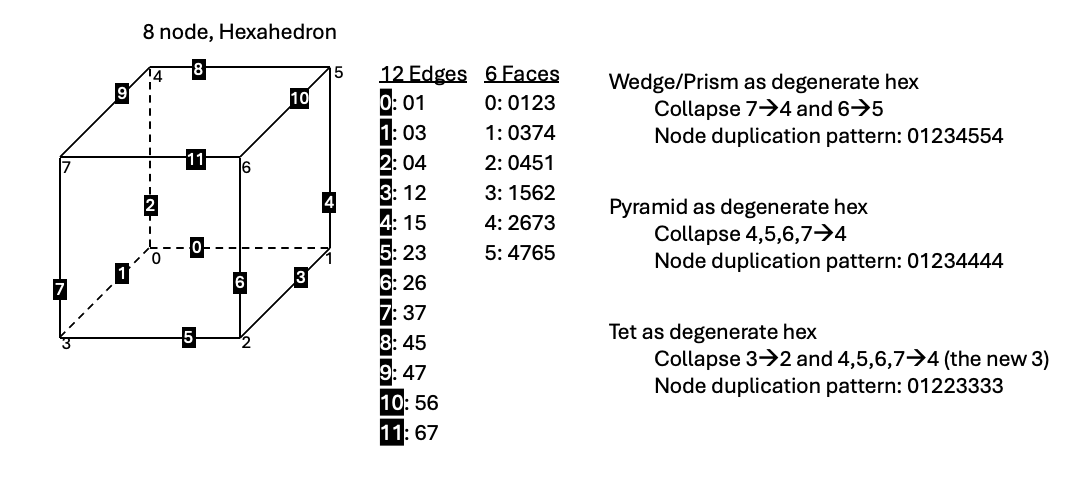
Node, edge and face ordering for Silo standard hex.
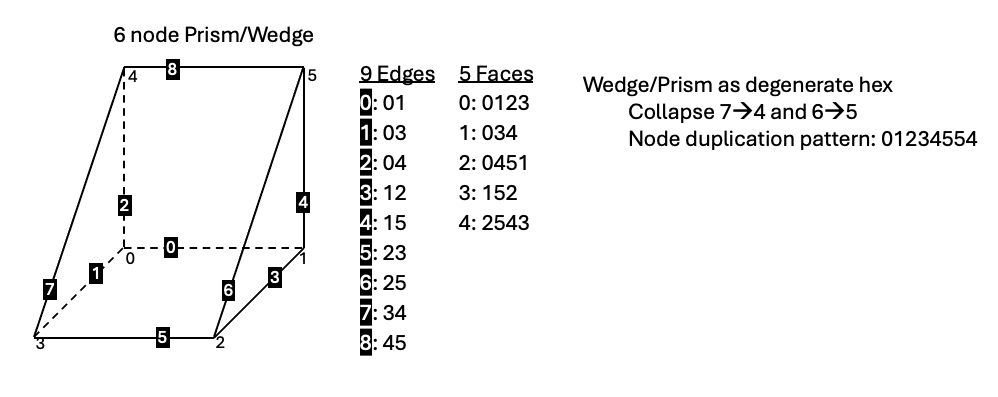
Node, edge and face ordering for Silo standard wedge/prism.
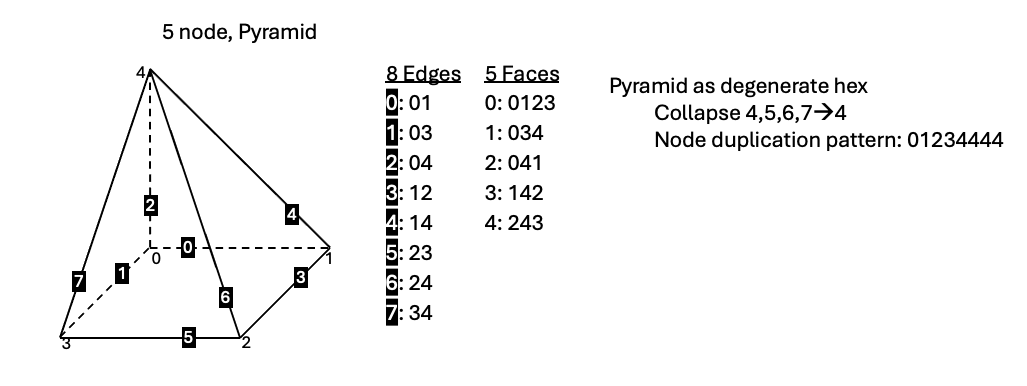
Node, edge and face ordering for Silo standard pyramid.
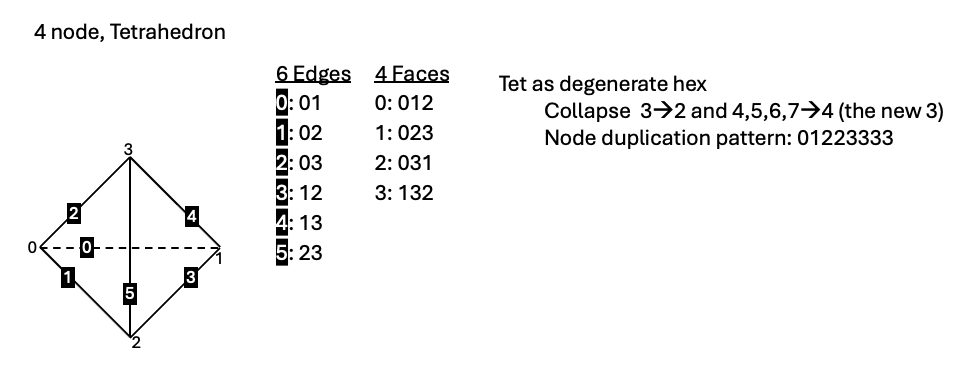
Node, edge and face ordering for Silo standard tet.
Given the node ordering in the Silo standard hexahedron, there is indeed an algorithm for determining the other orderings for the other shapes.
For edges, each edge is identified by a pair of integer indices; the first being the “tail” of an arrow oriented along the edge and the second being the “head” with the smaller node index always placed first (at the tail). Next, the ordering of edges is akin to a lexicographic ordering of these pairs of integers. This means that we start with the lowest node number of a cell shape, zero, and find all edges with node zero as one of the points on the edge. Each such edge will have zero as its tail. Since they all start with node 0 as the tail, we order these edges from smallest to largest “head” node. Then we go to the next lowest node number on the cell that has edges that have yet to have been placed in the ordering. We find all the edges from that node (that have not already been placed in the ordering) from smallest to largest “head” node. We continue this process until all the edges on the cell have been placed in the ordering.
For faces, a similar algorithm is used. Starting with the lowest numbered node on a face, we enumerate the nodes over a face using the right hand rule for the normal to the face pointing away from the innards of the cell. When one places the thumb of the right hand in the direction of this normal, the direction of the fingers curling around it identify the direction we go to identify the nodes of the face. Just as for edges, we start identifying faces for the lowest numbered node of the cell (0). We find all faces that share this node. Of these, the face that enumerates the next lowest node number as we traverse the nodes using the right hand rule, is placed first in the ordering. Then, the face that has the next lowest node number and so on.
Conventions for other standard shapes as degenerate hexahedra:
Finally, among the commonly used finite element shapes, hexahedra are frequently the only supported element type in many applications, particularly engineering applications. Sometimes, for developers of these applications it is easiest to support other element types such as tetrahedra, pyramids and/or prism/wedges, by simply handling them as degenerate hexahedra. This means that among the 8 nodes (e.g. corer points) of a hexahedron, some points are duplicated to pinch off or collapse an edge or face of a hexahedron to create the desired alternative shapes.
For degenerate hexahedra in Silo, creating these shapes as degenerate hexs in Silo is done following the pattern of collapsing two or more of the highest number nodes into a single node to produce the required shape. Form each edge by starting with lowest numbered node at tail and next highest numbered node on an incident edge as head. Repeat for all edges incident to this starting node. Then move to the next highest numbered node involving a new edge and repeat for all edges incident to that node. Form each face starting always with lowest numbered node in a face and working around it to the next highest numbered node on the face right-hand rule, outward normal order. Repeat for all faces incident to this starting node. Then, move to the next highest numbered node involving a new face and repeat for all faces incident to that node.
Global orderings of edges and faces:
For global traversals and orderings of all edges or faces in a mesh, the local orderings are repeated for each zone in the mesh starting with the first zone in the associated zonelist and, of course, skipping edges and faces encountered in later zones that are already accounted for by having been visited through an earlier zone in the traversal.
Example of zonelist data:
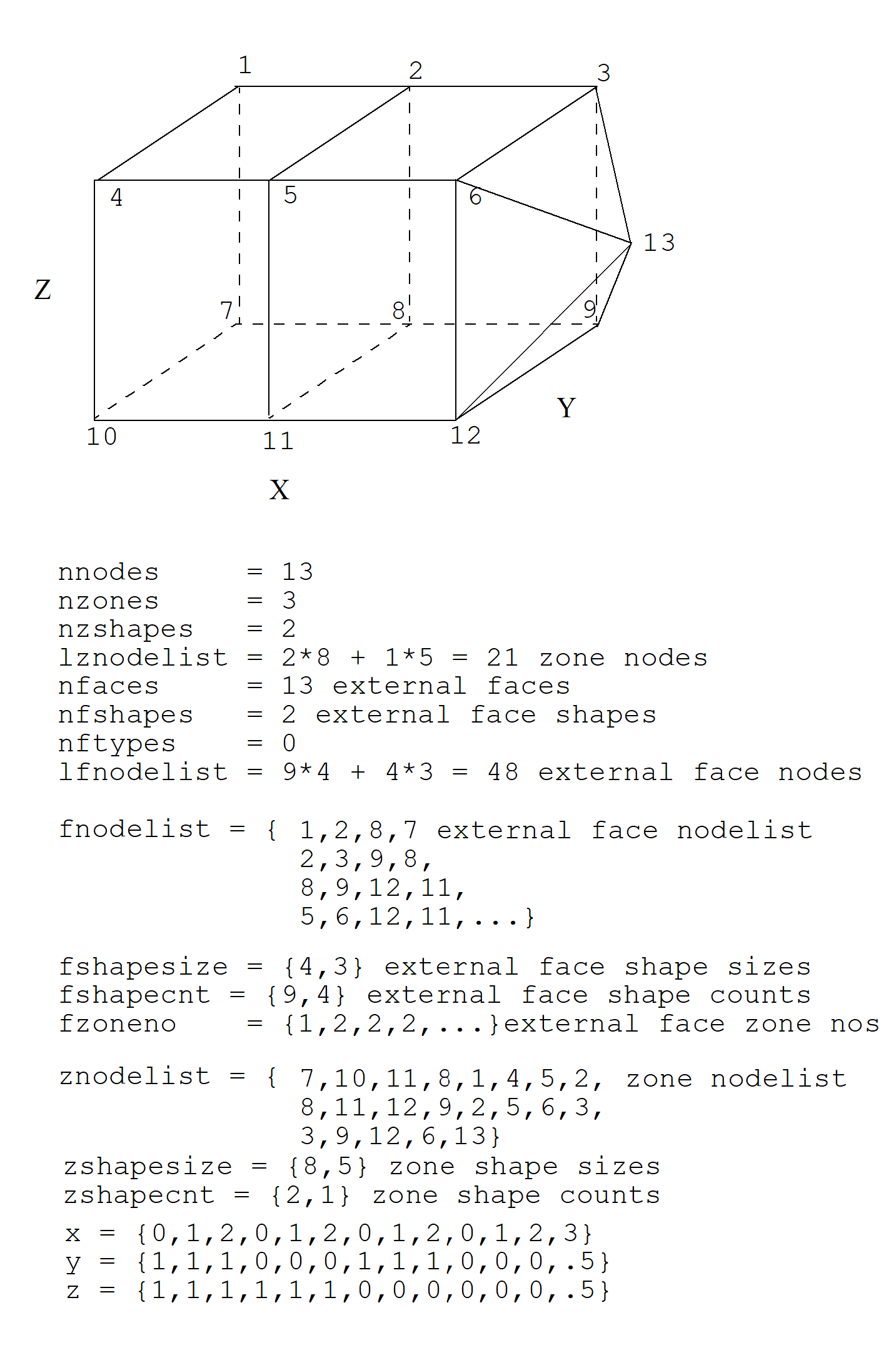
Example usage of UCD zonelist and external facelist variables.
Arbitrary polyhedral zonelists:
There are two ways of handling arbitrary polyehdral zones. One of these, the old way, is to encode arbitrary polyhedral zones directly into a standard zonelist using the
DB_ZONETYPE_POLYHEDRON. The other is to use a fully arbitrarily connected zonelist object via theDBPutPHZonelist()call.An example using arbitrary polyhedrons for some zones is illustrated, below. The nodes of a
DB_ZONETYPE_POLYHEDRONare specified in the following fashion: First specify the number of faces in the polyhedron. Then, for each face, specify the number of nodes in the face followed by the nodes that make up the face. The nodes should be ordered such that they are numbered in a counter-clockwise fashion when viewed from the outside (e.g. right-hand rules yields an outward facing normal). For a fully arbitrarily connected mesh, seeDBPutPHZonelist(). In addition, for a sequence of consecutive zones of typeDB_ZONETYPE_POLYHEDRONin a zonelist, the shapesize entry is taken to be the sum of all the associated positions occupied in the nodelist data. So, for the example in Figure 0-3 on page 106, the shapesize entry for theDB_ZONETYPE_POLYEDRONsegment of the zonelist is ‘53’ because for the two arbitrary polyhedral zones in the zonelist, 53 positions in the nodelist array are used.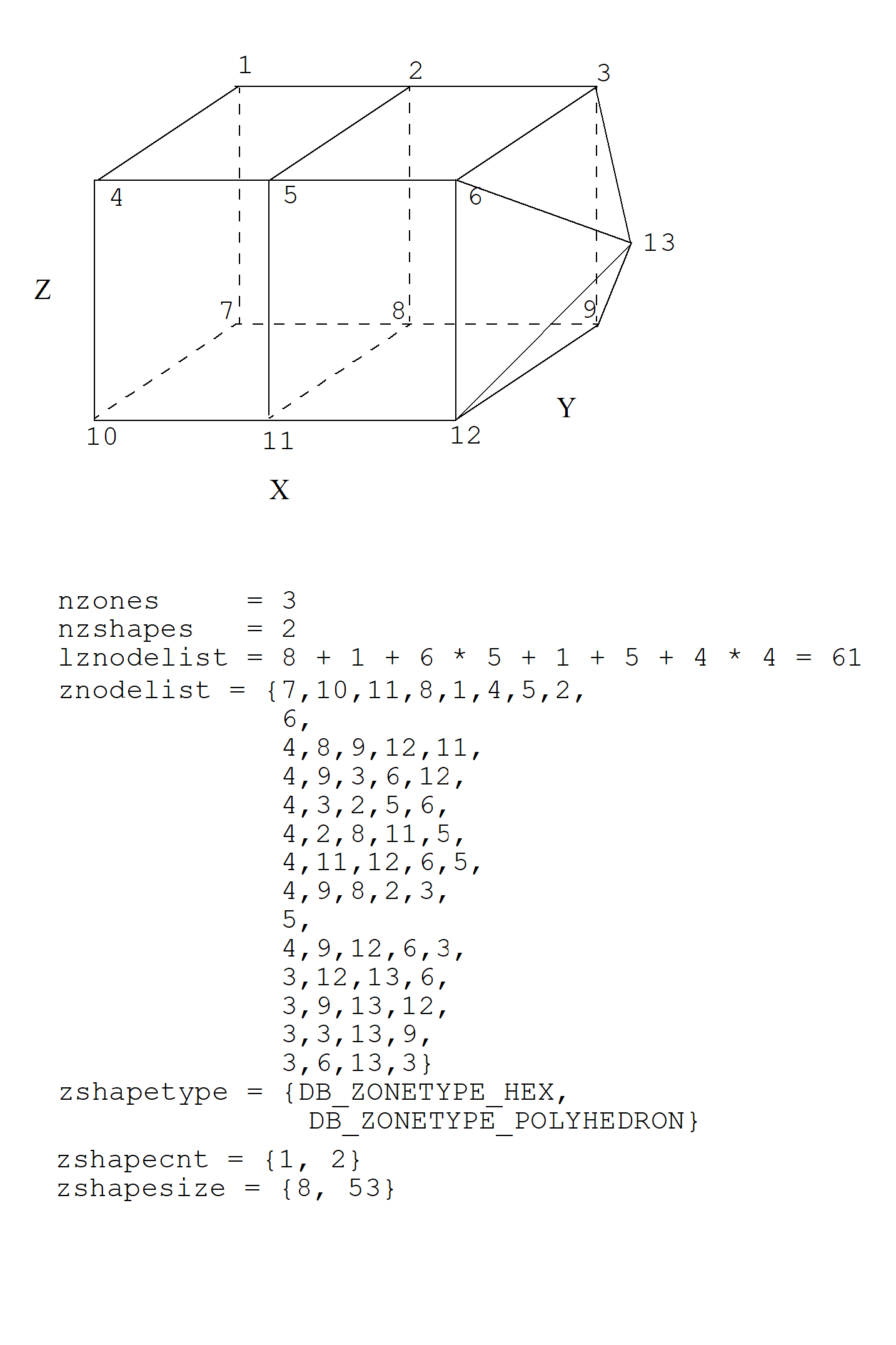
Example usage of UCD zonelist combining a hex and 2 polyhedra.
This example is intended to illustrate the representation of arbitrary polyhedra. So, although the two polyhedra represent a hex and pyramid which would ordinarily be handled just fine by a standard zonelist, they are expressed using arbitrary connectivity here for demonstration purposes.
The zonelist (connectivity) information for zoo-type elements is written with a call to
DBPutZonelist2. When there are only zoo-type elements in the mesh, this is the only zonelist information associated with the mesh. However, the caller can optionally specify thenameof an arbitrary, polyhedral zonelist written with a call toDBPutPHZonelistusing theDBOPT_PHZONELISToption. If the mesh consists solely of arbitrary, polyhedral elements, the only zonelist associated with the mesh will be the one written with the call toDBPutPHZonelist.When a mesh is composed of both zoo-type elements and polyhedral elements, it is assumed that all the zoo-type elements come first in the mesh followed by all the polyhedral elements. This has implications for any
DBPutUcdvarcalls made on such a mesh. For zone-centered data, the variable array should be organized so that values corresponding to zoo-type zones come first followed by values corresponding to polyhedral zones. Also, since both the zoo-type zonelist and the polyhedral zonelist support hi- and lo- offsets for ghost zones, the ghost-zones of a mesh may consist of zoo-type or polyhedral zones or a mixture of both.
DBPutPHZonelist()
Summary: Write an arbitrary, polyhedral zonelist object into a Silo file.
C Signature:
int DBPutPHZonelist (DBfile *dbfile, char const *name, int nfaces,
    int const *nodecnts, int lnodelist, int const *nodelist,
    char const *extface, int nzones, int const *facecnts,
    int lfacelist, int const *facelist, int origin,
    int lo_offset, int hi_offset, DBoptlist const *optlist)
Fortran Signature:
NoneArguments:
Arg name
Description
dbfileDatabase file pointer.
nameName of the zonelist structure.
nfacesNumber of faces in the zonelist. Note that faces shared between zones should only be counted once.
nodecntsArray of length
nfacesindicating the number of nodes in each face. That is nodecnts[i] is the number of nodes in face i.lnodelistLength of the succeeding
nodelistarray.nodelistArray of length
lnodelistlisting the nodes of each face. The list of nodes for face i begins at index Sum(nodecnts[j]) for j=0…i-1.extfaceAn optional array of length
nfaceswhere extface[i]!=0x0 means that face i is an external face. This argument may beNULL.nzonesNumber of zones in the zonelist.
facecntsArray of length
nzoneswhere facecnts[i] is number of faces for zone i.lfacelistLength of the succeeding
facelistarray.facelistArray of face ids for each zone. The list of faces for zone i begins at index Sum(facecnts[j]) for j=0…i-1. Note, however, that each face is identified by a signed value where the sign is used to indicate which ordering of the nodes of a face is to be used. A face id >= 0 means that the node ordering as it appears in the
nodelistshould be used. Otherwise, the value is negative and it should be 1-complimented to get the face’s true id. In addition, the node ordering for such a face is the opposite of how it appears in thenodelist. Finally, node orders over a face should be specified such that a right-hand rule yields the outward normal for the face relative to the zone it is being defined for.originOrigin for indices in the
nodelistarray. Should be zero or one.lo-offsetIndex of first real (e.g. non-ghost) zone in the list. All zones with index less than (<)
lo-offsetare treated as ghost-zones.hi-offsetIndex of last real (e.g. non-ghost) zone in the list. All zones with index greater than (>)
hi-offsetare treated as ghost zones.Returned value:
Returns zero on success or -1 on failure.
Description:
The
DBPutPHZonelistfunction writes a polyhedral-zonelist object into a Silo file. The name assigned to this object can in turn be used as the parameter in theDBOPT_PHZONELISToption for theDBPutUcdmeshfunction.The following table describes the options accepted by this function:
Option Name
Data Type
Option Meaning
Default Value
DBOPT_ZONENUMvoid*Array of global zone numbers, one per zone in this zonelist. By default, it is assumed this array is of type int*
NULLDBOPT_LLONGNZNUMintIndicates that the array passed for
DBOPT_ZONENUMoption is of long long type instead of int.0
DBOPT_GHOST_ZONE_LABELSchar*Optional array of char values indicating the ghost labeling
DB_GHOSTTYPE_NOGHOSTorDB_GHOSTTYPE_INTDUP) of each zoneNULLDBOPT_ALT_ZONENUM_VARSchar**A null terminated list of names of optional array(s) or
DBucdvarobjects indicating (multiple) alternative numbering(s) for zonesNULLIn interpreting the diagram above, numbers correspond to nodes while letters correspond to faces. In addition, the letters are drawn such that they will always be in the lower, right hand corner of a face if you were standing outside the object looking towards the given face. In the example code below, the list of nodes for a given face begin with the node nearest its corresponding letter.
For toplogically 2D meshes, two different approaches are possible for creating a polyhedral zonelist. One is to have a single list of “faces” representing the polygons of the 2D mesh. The other is to create an explicit list of “edges” and then define each polygon in terms of the edges it comprises. Either is appropriate.
#define NNODES 12
#define NFACES 11
#define NZONES 2

/* coordinate arrays */
float x[NNODES] = {0.0, 1.0, 2.0, 0.0, 1.0, 2.0, 0.0, 1.0, 2.0, 0.0, 1.0, 2.0};
float y[NNODES] = {0.0, 0.0, 0.0, 0.0, 0.0, 0.0, 1.0, 1.0, 1.0, 1.0, 1.0, 1.0};
float z[NNODES] = {0.0, 0.0, 0.0, 1.0, 1.0, 1.0, 0.0, 0.0, 0.0, 1.0, 1.0, 1.0};

/* facelist where we enumerate the nodes over each face */
int nodecnts[NFACES] = {4,4,4,4,4,4,4,4,4,4,4};
int lnodelist = 4*NFACES;

/*                           a           b           c      */
int nodelist[4*NFACES] = {1,7,6,0,    2,8,7,1     4,1,0,3,

/*                           d           e           f      */
5,2,1,4,    3,9,10,4,   4,10,11,5,

/*                           g           h           i      */
9,6,7,10,   10,7,8,11,  0,6,9,3,

/*                            j          K                  */
1,7,10,4,   5,11,8,2};

/* zonelist where we enumerate the faces over each zone */
int facecnts[NZONES] = {6,6};
int lfacelist = 6*NZONES;
int facelist[6*NZONES] = {0,2,4,6,8,-9,   1,3,5,7,9,10};
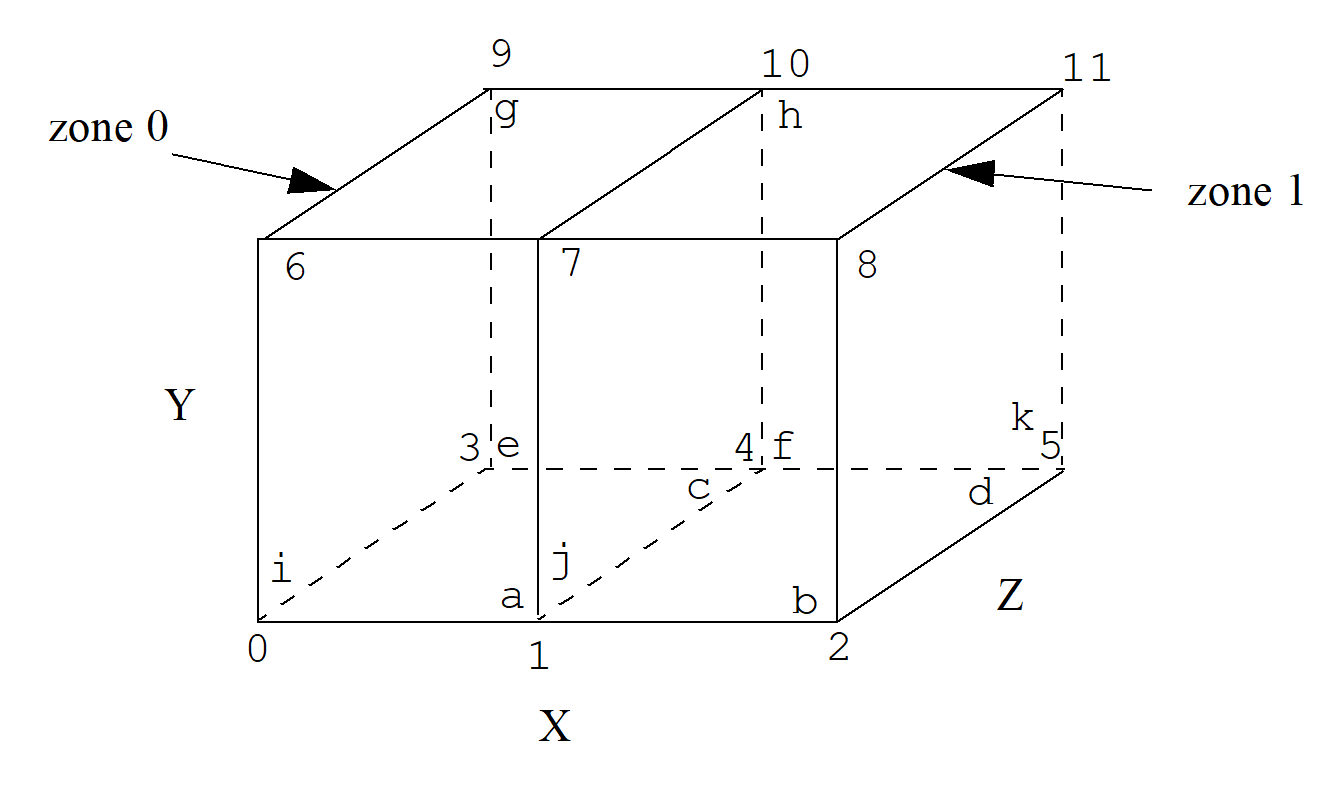
Example of a polyhedral zonelist representation for two hexahedral elements
DBGetPHZonelist()
Summary: Read a polyhedral-zonelist from a Silo database.
C Signature:
DBphzonelist *DBGetPHZonelist (DBfile *dbfile,
    char const *phzlname)
Fortran Signature:
NoneArguments:
Arg name
Description
dbfileDatabase file pointer.
phzlnameName of the polyhedral-zonelist.
Returned value:
Returns a pointer to a
DBphzoneliststructure on success andNULLon failure.Description:
The
DBGetPHZonelistfunction allocates aDBphzonelistdata structure, reads a polyhedral-zonelist from the Silo database, and returns a pointer to that structure. If an error occurs,NULLis returned.
DBPutFacelist()
Summary: Write a facelist object into a Silo file.
C Signature:
int DBPutFacelist (DBfile *dbfile, char const *name, int nfaces,
    int ndims, int const nodelist[], int lnodelist, int origin,
    int const zoneno[], int const shapesize[],
    int const shapecnt[], int nshapes, int const types[],
    int const typelist[], int ntypes)
Fortran Signature:
integer function dbputfl(dbid, name, lname, ndims nodelist,
   lnodelist, origin, zoneno, shapesize, shapecnt, nshaps,
   types, typelist, ntypes, status)
Arguments:
Arg name
Description
dbfileDatabase file pointer.
nameName of the facelist structure.
nfacesNumber of external faces in associated mesh.
ndimsNumber of spatial dimensions represented by the associated mesh.
nodelistArray of length
lnodelistcontaining node indices describing mesh faces.lnodelistLength of
nodelistarray.originOrigin for indices in
nodelistarray. Either zero or one.zonenoArray of length
nfacescontaining the zone number from which each face came. Use aNULLfor this parameter if zone numbering info is not wanted.shapesizeArray of length
nshapescontaining the number of nodes used by each face shape (for 3-D meshes only).shapecntArray of length
nshapescontaining the number of faces having each shape (for 3-D meshes only).nshapesNumber of face shapes (for 3-D meshes only).
typesArray of length
nfacescontaining information about each face. This argument is ignored ifntypesis zero, or if this parameter isNULL.typelistArray of length
ntypescontaining the identifiers for each type. This argument is ignored ifntypesis zero, or if this parameter isNULL.ntypesNumber of types, or zero if type information was not provided.
Returned value:
Returns zero on success or -1 on failure.
Description:
The
DBPutFacelistfunction writes a facelist object into a Silo file. Thenamegiven to this object can in turn be used as a parameter to theDBPutUcdmeshfunction.See
DBPutUcdmeshfor a full description of the facelist data structures.
DBPutUcdvar()
Summary: Write a scalar/vector/tensor UCD variable object into a Silo file.
C Signature:
int DBPutUcdvar (DBfile *dbfile, char const *name,
    char const *meshname, int nvars,
    char const * const varnames[], void const * const vars[],
    int nels, void const * const mixvars[], int mixlen,
    int datatype, int centering, DBoptlist const *optlist)
Fortran Signature:
NoneArguments:
Arg name
Description
dbfileDatabase file pointer.
nameName of the variable.
meshnameName of the mesh associated with this variable (written with DBPutUcdmesh).
nvarsNumber of sub-variables which comprise this variable. For a scalar array, this is one. If writing a vector quantity, however, this would be two for a 2-D vector and three for a 3-D vector.
varnamesArray of length
nvarscontaining pointers to character strings defining the names associated with each subvariable.varsArray of length
nvarscontaining pointers to arrays defining the values associated with each subvariable.nelsNumber of elements in this variable.
mixvarsArray of length
nvarscontaining pointers to arrays defining the mixed-data values associated with each subvariable. If no mixed values are present, this should beNULL.mixlenLength of mixed data arrays (i.e., mixvars).
datatypeDatatype of sub-variables. One of the predefined Silo data types.
centeringCentering of the sub-variables on the associated mesh. One of the predefined types:
DB_NODECENT,DB_EDGECENT,DB_FACECENT,DB_ZONECENTorDB_BLOCKCENT. See below for a discussion ofcenteringissues.optlistPointer to an option list structure containing additional information to be included in the variable object written into the Silo file. See the table below for the valid options for this function. If no options are to be provided, use
NULLfor this argument.Returned value:
Returns zero on success and -1 on failure.
Description:
The
DBPutUcdvarfunction writes a variable associated with an UCD mesh into a Silo file. Note that variables can be node-centered, zone-centered, edge-centered or face-centered.For node- (or zone-) centered data, the question of which value in the
varsarray goes with which node (or zone) is determined implicitly by a one-to-one correspondence with the list of nodes in theDBPutUcdmeshcall (or zones in theDBPutZonelistorDBPutZonelist2call). For example, the 237th value in a zone-centeredvarsarray passed here goes with the 237th zone in the zonelist passed in theDBPutZonelist2(or DBPutZonelist) call.Edge- and face-centered data require a little more explanation. Unlike node- and zone-centered data, there does not exist in Silo an explicit list of edges or faces. As an aside, the
DBPutFacelistcall is really for writing the external faces of a mesh so that a downstream visualization tool need not have to compute them when it displays the mesh. Now, requiring the caller to create explicit lists of edges and/or faces in order to handle edge- or face-centered data results in unnecessary additional data being written to a Silo file. This increases file size as well as the time to write and read the file. To avoid this, we rely upon implicit lists of edges and faces.We define implicit lists of edges and faces in terms of a traversal of the zonelist structure of the associated mesh. The position of an edge (or face) in its list is determined by the order of its first occurrence in this traversal. The traversal algorithm is to visit each zone in the zonelist and, for each zone, visit its edges (or faces) in local order. See figure showing UCD zoo and node, edge and face orderings Because this traversal will wind up visiting edges multiple times, the first time an edge (or face) is encountered is what determines its position in the implicit edge (or face) list.
If the zonelist contains arbitrary polyhedra or the zonelist is a polyhedral zonelist (written with DBPutPHZonelist), then the traversal algorithm involves visiting each zone, then each face for a zone and finally each edge for a face.
Note that
DBPutUcdvar()can also be used to define a block-centered variable on a multi-block mesh by specifying a multi-block meshnamefor themeshnameandDB_BLOCKCENTfor thecentering. This is useful in defining, for example, multi-block variable extents.Other information can also be included. This function is useful for writing vector and tensor fields, whereas the companion function, DBPutUcdvar1, is appropriate for writing scalar fields.
For tensor quantities, the question of ordering of tensor components arises. For symmetric tensor’s Silo uses the Voigt Notation ordering. In 2D, this is
T11,T22,T12. In 3D, this isT11,T22,T33,T23,T13,T12. For full tensor quantities, ordering is row by row starting with the top row.The following table describes the options accepted by this function:
Optlist options:
Option Name
Value Data Type
Option Meaning
Default Value
DBOPT_COORDSYSintCoordinate system. One of:
DB_CARTESIAN,DB_CYLINDRICAL,DB_SPHERICAL,DB_NUMERICAL, orDB_OTHERDB_OTHERDBOPT_CYCLEintProblem cycle value.
0
DBOPT_LABELchar*Character strings defining the label associated with this variable
NULLDBOPT_ORIGINintOrigin for arrays. Zero or one.
0
DBOPT_TIMEfloatProblem time value.
0.0
DBOPT_DTIMEdoubleProblem time value.
0.0
DBOPT_UNITSchar*Character string defining the units associated with this variable
NULLDBOPT_USESPECMFintBoolean
DB_OFForDB_ON) value specifying whether or not to weight the variable by the species mass fraction when using material species dataDB_OFFDBOPT_ASCII_LABELintIndicate if the variable should be treated as single character, ascii values. A value of 1 indicates yes, 0 no.
0
DBOPT_HIDE_FROM_GUIintSpecify a non-zero value if you do not want this object to appear in menus of downstream tools
0
DBOPT_REGION_PNAMESchar**A null-pointer terminated array of pointers to strings specifying the pathnames of regions in the mrg tree for the associated mesh where the variable is defined. If there is no mrg tree associated with the mesh, the names specified here will be assumed to be material names of the material object associated with the mesh. The last pointer in the array must be null and is used to indicate the end of the list of names. See
DBOPT_REGION_PNAMESNULLDBOPT_CONSERVEDintIndicates if the variable represents a physical quantity that must be conserved under various operations such as interpolation.
0
DBOPT_EXTENSIVEintIndicates if the variable represents a physical quantity that is extensive (as opposed to intensive). Note, while it is true that any conserved quantity is extensive, the converse is not true. By default and historically, all Silo variables are treated as intensive.
0
DBOPT_MISSING_VALUEdoubleSpecify a numerical value that is intended to represent “missing values” in the variable data arrays. Default is
DB_MISSING_VALUE_NOT_SETDB_MISSING_VALUE_NOT_SET
DBPutUcdvar1()
Summary: Write a scalar UCD variable object into a Silo file.
C Signature:
int DBPutUcdvar1 (DBfile *dbfile, char const *name,
    char const *meshname, void const *var, int nels,
    void const *mixvar, int mixlen, int datatype, int centering,
    DBoptlist const *optlist)
Fortran Signature:
integer function dbputuv1(dbid, name, lname, meshname,
   lmeshname, var, nels, mixvar, mixlen, datatype,
   centering, optlist_id, staus)
Arguments:
Arg name
Description
dbfileDatabase file pointer.
nameName of the variable.
meshnameName of the mesh associated with this variable (written with either DBPutUcdmesh).
varArray of length
nelscontaining the values associated with this variable.nelsNumber of elements in this variable.
mixvarArray of length
mixlencontaining the mixed-data values associated with this variable. Ifmixlenis zero, this value is ignored.mixlenLength of
mixvararray. If zero, no mixed data is present.datatypeDatatype of variable. One of the predefined Silo data types.
centeringCentering of the sub-variables on the associated mesh. One of the predefined types:
DB_NODECENT,DB_EDGECENT,DB_FACECENTorDB_ZONECENT.optlistPointer to an option list structure containing additional information to be included in the variable object written into the Silo file. See the table below for the valid options for this function. If no options are to be provided, use
NULLfor this argument.Returned value:
Returns zero on success and -1 on failure.
Description:
DBPutUcdvar1 writes a variable associated with an UCD mesh into a Silo file. Note that variables will be either node-centered or zone-centered. Other information can also be included. This function is useful for writing scalar fields, whereas the companion function, DBPutUcdvar, is appropriate for writing vector and tensor fields.
See
DBPutUcdvarfor a description of options accepted by this function.
DBGetUcdvar()
Summary: Read a UCD variable from a Silo database.
C Signature:
DBucdvar *DBGetUcdvar (DBfile *dbfile, char const *varname)
Fortran Signature:
NoneArguments:
Arg name
Description
dbfileDatabase file pointer.
varnameName of the variable.
Returned value:
Returns a pointer to a
DBucdvarstructure on success andNULLon failure.Description:
The
DBGetUcdvarfunction allocates aDBucdvardata structure, reads a variable associated with a UCD mesh from the Silo database, and returns a pointer to that structure. If an error occurs,NULLis returned.
DBPutCsgmesh()
Summary: Write a CSG mesh object to a Silo file
C Signature:
DBPutCsgmesh(DBfile *dbfile, const char *name, int ndims,
    int nbounds,
    const int *typeflags, const int *bndids,
    const void *coeffs, int lcoeffs, int datatype,
    const double *extents, const char *zonel_name,
    DBoptlist const *optlist);
Fortran Signature:
integer function dbputcsgm(dbid, name, lname, ndims,
   nbounds, typeflags, bndids, coeffs, lcoeffs, datatype,
   extents, zonel_name, lzonel_name, optlist_id, status)
Arguments:
Arg name
Description
dbfileDatabase file pointer
nameName to associate with this
DBcsgmeshobjectndimsNumber of spatial and topological dimensions of the CSG mesh object
nboundsNumber of boundaries in the CSG mesh description.
typeflagsInteger array of length
nboundsof type information for each boundary. This is used to encode various information about the type of each boundary such as, for example, plane, sphere, cone, general quadric, etc as well as the number of coefficients in the representation of the boundary. For more information, see the description, below.bndidsOptional integer array of length
nboundswhich are the explicit integer identifiers for each boundary. It is these identifiers that are used in expressions defining a region of the CSG mesh. If the caller passesNULLfor this argument, a natural numbering of boundaries is assumed. That is, the boundary occurring at position i, starting from zero, in the list of boundaries here is identified by the integer i.coeffsArray of length
lcoeffsof coefficients used in the representation of each boundary or, if the boundary is a transformed copy of another boundary, the coefficients of the transformation. In the case where a given boundary is a transformation of another boundary, the first entry in thecoeffsentries for the boundary is the (integer) identifier for the referenced boundary. Consequently, if thedatatypeforcoeffsisDB_FLOAT, there is an upper limit of about 16.7 million (2^24) boundaries that can be referenced in this way.lcoeffsLength of the
coeffsarray.datatypeThe data type of the data in the
coeffsarray.zonel_nameName of CSG zonelist to be associated with this CSG mesh object
extentsArray of length 2*ndims of spatial extents, xy(z)-minimums followed by xy(z)-maximums.
optlistPointer to an option list structure containing additional information to be included in the CSG mesh object written into the Silo file. Use
NULLif there are no options.Returned value:
Returns zero on success and -1 on failure.
Description:
The word mesh in this function name is probably somewhat misleading because it suggests a discretization of a domain into a mesh. In fact, a CSG (Constructive Solid Geometry) mesh in Silo is a continuous, analytic representation of the geometry of some computational domain. Nonetheless, most of Silo’s concepts for meshes, variables, materials, species and multi-block objects apply equally well in the case of a CSG mesh and so that is what it is called, here. Presently, Silo does not have functions to discretize this kind of mesh. It has only the functions for storing and retrieving it. Nonetheless, a future version of Silo may include functions to discretize a CSG mesh.
A CSG mesh is constructed by starting with a list of analytic boundaries, that is curves in 2D or surfaces in 3D, such as planes, spheres and cones or general quadrics. Each boundary is defined by an analytic expression (an equation) of the form f(x,y,z)=0 (or, in 2D, f(x,y)=0) in which the highest exponent for x, y or z is 2. That is, all the boundaries are quadratic (or quadric) at most.
The table below describes how to use the
typeflagsargument to define various kinds of boundaries in 3 dimensions.Optlist options:
typeflag
num-coeffs
coefficients and equation
DBCSG_QUADRIC_G
10
DBCSG_SPHERE_PR
4
DBCSG_ELLIPSOID_PRRR
6
DBCSG_PLANE_G
4
DBCSG_PLANE_X
1
DBCSG_PLANE_Y
1
DBCSG_PLANE_Z
1
DBCSG_PLANE_PN
6
DBCSG_PLANE_PPP
9
DBCSG_CYLINDER_PNLR
8
to be completed
DBCSG_CYLINDER_PPR
7
to be completed
DBCSG_BOX_XYZXYZ
6
to be completed
DBCSG_CONE_PNLA
8
to be completed
DBCSG_CONE_PPA
to be completed
DBCSG_POLYHEDRON_KF
K
6K
DBCSG_HEX_6F
36
to be completed
DBCSG_TET_4F
24
to be completed
DBCSG_PYRAMID_5F
30
to be completed
DBCSG_PRISM_5F
30
to be completed
The table below defines an analogous set of
typeflagsfor creating boundaries in two dimensions..typeflag
num-coeffs
coefficients and equation
DBCSG_QUADRATIC_G
6
DBCSG_CIRCLE_PR
3
DBCSG_ELLIPSE_PRR
4
DBCSG_LINE_G
3
DBCSG_LINE_X
1
DBCSG_LINE_Y
1
DBCSG_LINE_PN
4
DBCSG_LINE_PP
4
DBCSG_BOX_XYXY
4
to be completed
DBCSG_POLYGON_KP
K
2K
DBCSG_TRI_3P
6
to be completed
DBCSG_QUAD_4P
8
to be completed
By replacing the ‘=’ in the equation for a boundary with either a ‘<’ or a ‘>’, whole regions in 2 or 3D space can be defined using these boundaries. These regions represent the set of all points that satisfy the inequality. In addition, regions can be combined to form new regions by unions, intersections and differences as well other operations (See
DBPutCSGZonelist).In this call, only the analytic boundaries used in the expressions to define the regions are written. The expressions defining the regions themselves are written in a separate call,
DBPutCSGZonelist.If you compare this call to write a CSG mesh to a Silo file with a similar call to write a UCD mesh, you will notice that the boundary list here plays a role similar to that of the nodal coordinates of a UCD mesh. For the UCD mesh, the basic geometric primitives are points (nodes) and a separate call, DBPutZonelist, is used to write out the information that defines how points (nodes) are combined to form the zones of the mesh.
Similarly, here the basic geometric primitives are analytic boundaries and a separate call, DBPutCSGZonelist, is used to write out the information that defines how the boundaries are combined to form regions of the mesh.
The following table describes the options accepted by this function. See the section titled “Using the Silo Option Parameter” for details on the use of the
DBoptlistconstruct.Option Name
Data Type
Option Meaning
Default Value
DBOPT_CYCLEintProblem cycle value
0
DBOPT_TIMEfloatProblem time value.
0.0
DBOPT_DTIMEdoubleProblem time value.
0.0
DBOPT_XLABELchar*Character string defining the label associated with the X dimension
NULLDBOPT_YLABELchar*Character string defining the label associated with the Y dimension
NULLDBOPT_ZLABELchar*Character string defining the label associated with the Z dimension
NULLDBOPT_XUNITSchar*Character string defining the units associated with the X dimension
NULLDBOPT_YUNITSchar*Character string defining the units associated with the Y dimension
NULLDBOPT_ZUNITSchar*Character string defining the units associated with the Z dimension
NULLDBOPT_BNDNAMESchar**Array of nboundaries character strings defining the names of the individual boundaries
NULLDBOPT_HIDE_FROM_GUIintSpecify a non-zero value if you do not want this object to appear in menus of downstream tools
0
DBOPT_MRGTREE_NAMEchar*Name of the mesh region grouping tree to be associated with this mesh
NULLDBOPT_TV_CONNECTIVTYintA non-zero value indicates that the connectivity of the mesh varies with time
0
DBOPT_DISJOINT_MODEintIndicates if any elements in the mesh are disjoint. There are two possible modes. One is
DB_ABUTTINGindicating that elements abut spatially but actually reference different node ids (but spatially equivalent nodal positions) in the node list. The other isDB_FLOATINGwhere elements neither share nodes in the nodelist nor abut spatiallyDB_NONEDBOPT_ALT_NODENUM_VARSchar**A null terminated list of names of optional array(s) or
DBcsgvarobjects indicating (multiple) alternative numbering(s) for boundariesNULLThe following options have been deprecated. Use MRG trees instead
DBOPT_GROUPNUMintThe group number to which this quadmesh belongs.
-1 (not in a group)
DBGetCsgmesh()
Summary: Get a CSG mesh object from a Silo file
C Signature:
DBcsgmesh *DBGetCsgmesh(DBfile *dbfile, const char *meshname)
Fortran Signature:
NoneArguments:
Arg name
Description
dbfileDatabase file pointer
meshnameName of the CSG mesh object to read
Returned value:
A pointer to a
DBcsgmeshstructure on success andNULLon failure.
DBPutCSGZonelist()
Summary: Put a CSG zonelist object in a Silo file.
C Signature:
int DBPutCSGZonelist(DBfile *dbfile, const char *name, int nregs,
    const int *typeflags,
    const int *leftids, const int *rightids,
    const void *xforms, int lxforms, int datatype,
    int nzones, const int *zonelist,
    DBoptlist *optlist);
Fortran Signature:
integer function dbputcsgzl(dbid, name, lname, nregs,
   typeflags, leftids, rightids, xforms, lxforms, datatype,
   nzones, zonelist, optlist_id, status)
Arguments:
Arg name
Description
dbfileDatabase file pointer
nameName to associate with the
DBcsgzonelistobjectnregsThe number of regions in the regionlist.
typeflagsInteger array of length
nregsof type information for each region. Each entry in this array is one of eitherDB_INNER,DB_OUTER,DB_ON,DB_XFORM,DB_SWEEP,DB_UNION,DB_INTERSECT, andDB_DIFF.
The symbols,DB_INNER,DB_OUTER,DB_ON,DB_XFORMandDB_SWEEPrepresent unary operators applied to the referenced region (or boundary). The symbolsDB_UNION,DB_INTERSECT, andDB_DIFFrepresent binary operators applied to two referenced regions.
For the unary operators,DB_INNERforms a region from a boundary (SeeDBPutCsgmesh) by replacing the ‘=’ in the equation representing the boundary with ‘<’. Likewise,DB_OUTERforms a region from a boundary by replacing the ‘=’ in the equation representing the boundary with ‘>’. Finally,DB_ONforms a region (of topological dimension one less than the mesh) by leaving the ‘=’ in the equation representing the boundary as an ‘=’. In the case ofDB_INNER,DB_OUTERandDB_ON, the corresponding entry in theleftidsarray is a reference to a boundary in the boundary list (SeeDBPutCsgmesh).
For the unary operator,DB_XFORM, the corresponding entry in theleftidsarray is a reference to a region to be transformed while the corresponding entry in therightidsarray is the index into the xform array of the row-by-row coefficients of the affine transform. The unary operatorDB_SWEEPis not yet implemented.leftidsInteger array of length
nregsof references to other regions in the regionlist or boundaries in the boundary list (SeeDBPutCsgmesh). Each referenced region in theleftidsarray forms the left operand of a binary expression (or single operand of a unary expression) involving the referenced region or boundary.rightidsInteger array of length
nregsof references to other regions in the regionlist. Each referenced region in therightidsarray forms the right operand of a binary expression involving the region or, for regions which are copies of other regions with a transformation applied, the starting index into thexformsarray of the row-by-row, affine transform coefficients. If for a given region no right reference is appropriate, put a value of ‘-1’ into this array for the given region.xformsArray of length
lxformsof row-by-row affine transform coefficients for those regions that are copies of other regions except with a transformation applied. In this case, the entry in theleftidsarray indicates the region being copied and transformed and the entry in therightidsarray is the starting index into thisxformsarray for the transform coefficients. This argument may beNULL.lxformsLength of the
xformsarray. This argument may be zero ifxformsisNULL.datatypeThe data type of the values in the
xformsarray. Ignored ifxformsisNULL.nzonesThe number of zones in the CSG mesh. A zone is really just a completely defined region.
zonelistInteger array of length
nzonesof the regions in the regionlist that form the actual zones of the CSG mesh.optlistPointer to an option list structure containing additional information to be included in this object when it is written to the Silo file. Use
NULLif there are no options.Returned value:
Returns zero on success and -1 on failure.
Description:
A CSG mesh is a list of curves in 2D or surfaces in 3D. These are analytic expressions of the boundaries of objects that can be expressed by quadratic equations in x, y and z.
The
zonelistfor a CSG mesh is constructed by first defining regions from the mesh boundaries. For example, given the boundary for a sphere, we can create a region by taking the insideDB_INNER) of that boundary or by taking the outsideDB_OUTER). In addition, regions can also be created by boolean operations (union, intersect, diff) on other regions. The table below summarizes how to construct regions using thetypeflagsargument.Optlist options:
op. symbol name
type
meaning
DBCSG_INNERunary
specifies the region created by all points satisfying the equation defining the boundary with
<replacing=, left operand indicates the boundary, right operand ignoredDBCSG_OUTERunary
specifies the region created by all points satisfying the equation defining the boundary with
>replacing=, left operand indicates the boundary, right operand ignoredDBCSG_ONunary
specifies the region created by all points satisfying the equation defining the boundary left operand indicates the boundary, right operand ignored
DBCSG_UNIONbinary
take the union of left and right operands left and right operands indicate the regions
DBCSG_INTERSECTbinary
take the intersection of left and right operands left and right operands indicate the regions
DBCSG_DIFFbinary
subtract the right operand from the left left and right operands indicate the regions
DBCSG_COMPLIMENTunary
take the compliment of the left operand, left operand indicates the region, right operand ignored
DBCSG_XFORMunary
to be implemented
DBCSG_SWEEPunary
to be implemented
However, not all regions in a CSG
zonelistform the actual zones of a CSG mesh. Some regions exist only to facilitate the construction of other regions. Only certain regions, those that are completely constructed, form the actual zones. Consequently, thezonelistfor a CSG mesh involves both a list of regions (as well as the definition of those regions) and then a list of zones (which are really just completely defined regions).The following table describes the options accepted by this function. See the section titled “Using the Silo Option Parameter” for details on the use of the
DBoptlistconstruct.Option Name
Data Type
Option Meaning
Default Value
DBOPT_REGNAMESchar**Array of
nregscharacter strings defining the names of the individual regionsNULLDBOPT_ZONENAMESchar**Array of
nzonescharacter strings defining the names of individual zonesNULLDBOPT_ALT_ZONENUM_VARSchar**A null terminated list of names of optional array(s) or
DBcsgvarobjects indicating (multiple) alternative numbering(s) for zonesNULL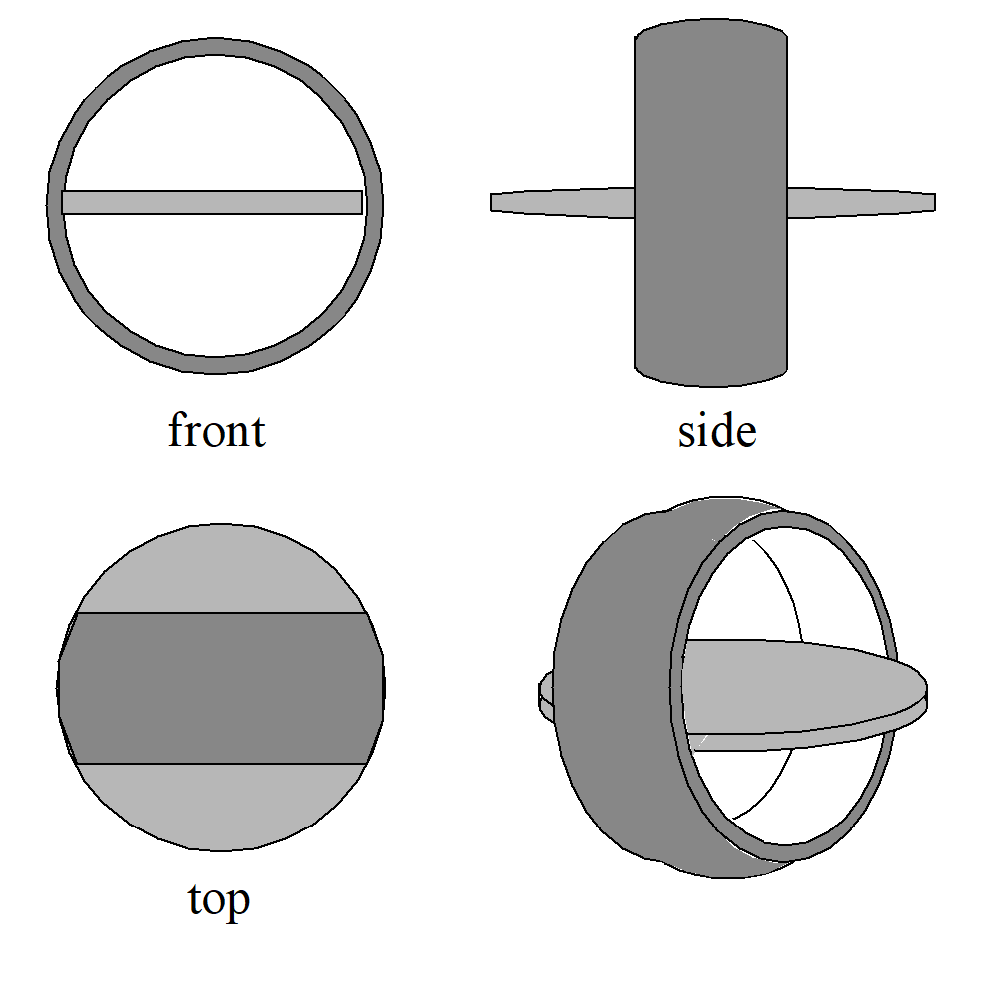
Figure 0-5: A relatively simple object to represent as a CSG mesh. It models an A/C vent outlet for a 1994 Toyota Tercel. It consists of two zones. One is a partially-spherical shaped ring housing (darker area). The other is a lens-shaped fin used to direct airflow (lighter area).
The table below describes the contents of the boundary list (written in the
DBPutCsgmeshcall)typeflags
id
coefficients
name (optional)
DBCSG_SPHERE_PR0
0.0, 0.0, 0.0, 5.0
“housing outer shell”
DBCSG_PLANE_X1
-2.5
“housing front”
DBCSG_PLANE_X2
2.5
“housing back”
DBCSG_CYLINDER_PPR3
0.0, 0.0, 0.0, 1.0, 0.0. 0.0, 3.0
“housing cavity”
DBCSG_SPHERE_PR4
0.0, 0.0, 49.5, 50.0
“fin top side”
DBCSG_SPHERE_PR5
0.0. 0.0, -49.5, 50.0
“fin bottom side”
The code below writes this CSG mesh to a silo file
int *typeflags={DBCSG_SPHERE_PR, DBCSG_PLANE_X, DBCSG_PLANE_X,
                DBCSG_CYLINDER_PPR, DBCSG_SPHERE_PR, DBCSG_SPHERE_PR};
float *coeffs = {0.0, 0.0, 0.0, 5.0, 1.0, 0.0, 0.0, -2.5,
                 1.0, 0.0, 0.0, 2.5, 1.0, 0.0, 0.0, 0.0, 3.0,
                 0.0, 0.0, 49.5, 50.0, 0.0.
                 0.0, -49.5, 50.0};

DBPutCsgmesh(dbfile, "csgmesh", 3, typeflags, NULL,
    coeffs, 25, DB_FLOAT, "csgzl", NULL);
The table below describes the contents of the regionlist, written in the
DBPutCSGZonelistcall.typeflags
regid
leftids
rightids
notes
DBCSG_INNER0
0
-1
creates inner sphere region from boundary 0
DBCSG_INNER1
1
-1
creates front half-space region from boundary 1
DBCSG_OUTER2
2
-1
creates back half-space region from boundary 2
DBCSG_INNER3
3
-1
creates inner cavity region from boundary 3
DBCSG_INTERSECT4
0
1
cuts front of sphere by intersecting regions 0 &1
DBCSG_INTERSECT5
4
2
cuts back of sphere by intersecting regions 4 & 2
DBCSG_DIFF6
5
3
creates cavity in sphere by removing region 3
DBCSG_INNER7
4
-1
creates large sphere region for fin upper surface from boundary 4
DBCSG_INNER8
5
-1
creates large sphere region for fin lower surface from boundary 5
DBCSG_INTERSECT9
7
8
creates lens-shaped fin with razor edge protruding from sphere housing by intersecting regions 7 & 8
DBCSG_INTERSECT10
9
0
cuts razor edge of lens-shaped fin to sphere housing
The table above creates 11 regions, only 2 of which form the actual zones of the CSG mesh. The 2 complete zones are for the spherical ring housing and the lens-shaped fin that sits inside it. They are identified by region ids 6 and 10. The other regions exist solely to facilitate the construction. The code to write this CSG
zonelistto a silo file is given below.int nregs = 11; int *typeflags={DBCSG_INNER, DBCSG_INNER, DBCSG_OUTER, DBCSG_INNER, DBCSG_INTERSECT, DBCSG_INTERSECT, DBCSG_DIFF, DBCSG_INNER, DBCSG_INNER, DBCSG_INTERSECT, DBCSG_INTERSECT}; int *leftids={0,1,2,3,0,4,5,4,5,7,9}; int *rightids={-1,-1,-1,-1,1,2,3,-1,-1,8,0}; int nzones = 2; int *zonelist = {6, 10}; DBPutCSGZonelist(dbfile, "csgzl", nregs, typeflags, leftids, rightids, NULL, 0, DB_INT, nzones, zonelist, NULL);
DBGetCSGZonelist()
Summary: Read a CSG mesh zonelist from a Silo file
C Signature:
DBcsgzonelist *DBGetCSGZonelist(DBfile *dbfile,
    const char *zlname)
Fortran Signature:
NoneArguments:
Arg name
Description
dbfileDatabase file pointer
zlnameName of the CSG mesh zonelist object to read
Returned value:
A pointer to a
DBcsgzoneliststructure on success andNULLon failure.
DBPutCsgvar()
Summary: Write a CSG mesh variable to a Silo file
C Signature:
int DBPutCsgvar(DBfile *dbfile, const char *vname,
    const char *meshname, int nvars,
    const char * const varnames[],
    const void * const vars[], int nvals, int datatype,
    int centering, DBoptlist const *optlist);
Fortran Signature:
integer function dbputcsgv(dbid, vname, lvname, meshname,
   lmeshname, nvars, var_ids, nvals, datatype, centering,
   optlist_id, status)

integer* var_ids (array of "pointer ids" created using dbmkptr)
Arguments:
Arg name
Description
dbfileDatabase file pointer
vnameThe name to be associated with this
DBcsgvarobjectmeshnameThe name of the CSG mesh this variable is associated with
nvarsThe number of subvariables comprising this CSG variable
varnamesArray of length
nvarscontaining the names of the subvariablesvarsArray of pointers to variable data
nvalsNumber of values in each of the
varsarraysdatatypeThe type of data in the
varsarrays (e.g.DB_FLOAT,DB_DOUBLE)centeringThe
centeringof the CSG variableDB_ZONECENTorDB_BNDCENT)optlistPointer to an option list structure containing additional information to be included in this object when it is written to the Silo file. Use
NULLif there are no optionsDescription:
The
DBPutCsgvarfunction writes a variable associated with a CSG mesh into a Silo file. Note that variables will be either zone-centered or boundary-centered.Just as UCD variables can be zone-centered or node-centered, CSG variables can be zone-centered or boundary-centered. For a zone-centered variable, the value(s) at index i in the
varsarray(s) are associated with the ith region (zone) in theDBcsgzonelistobject associated with the mesh. For a boundary-centered variable, the value(s) at index i in thevarsarray(s) are associated with the ith boundary in theDBcsgbndlist associated with the mesh.Other information can also be included via the optlist:
Optlist options:
Option Name
Value Data Type
Option Meaning
Default Value
DBOPT_CYCLEintProblem cycle value.
0
DBOPT_LABELchar*Character strings defining the label associated with this variable
NULLDBOPT_TIMEfloatProblem time value.
0.0
DBOPT_DTIMEdoubleProblem time value.
0.0
DBOPT_UNITSchar*Character string defining the units associated with this variable
NULLDBOPT_USESPECMFintBoolean
DB_OFForDB_ON) value specifying whether or not to weight the variable by the species mass fraction when using material species dataDB_OFFDBOPT_ASCII_LABELintIndicate if the variable should be treated as single character, ascii values. A value of 1 indicates yes, 0 no.
0
DBOPT_HIDE_FROM_GUIintSpecify a non-zero value if you do not want this object to appear in menus of downstream tools
0
DBOPT_REGION_PNAMESchar**A null-pointer terminated array of pointers to strings specifying the pathnames of regions in the mrg tree for the associated mesh where the variable is defined. If there is no mrg tree associated with the mesh, the names specified here will be assumed to be material names of the material object associated with the mesh. The last pointer in the array must be null and is used to indicate the end of the list of names. See
DBOPT_REGION_PNAMESNULLDBOPT_CONSERVEDintIndicates if the variable represents a physical quantity that must be conserved under various operations such as interpolation.
0
DBOPT_EXTENSIVEintIndicates if the variable represents a physical quantity that is extensive (as opposed to intensive). Note, while it is true that any conserved quantity is extensive, the converse is not true. By default and historically, all Silo variables are treated as intensive.
0
DBOPT_MISSING_VALUEdoubleSpecify a numerical value that is intended to represent “missing values” in the x or y data arrays. Default is
DB_MISSING_VALUE_NOT_SETDB_MISSING_VALUE_NOT_SET
DBGetCsgvar()
Summary: Read a CSG mesh variable from a Silo file
C Signature:
DBcsgvar *DBGetCsgvar(DBfile *dbfile, const char *varname)
Fortran Signature:
NoneArguments:
Arg name
Description
dbfileDatabase file pointer
varnameName of CSG variable object to read
Returned value:
A pointer to a
DBcsgvarstructure on success andNULLon failure.
DBPutMaterial()
Summary: Write a material data object into a Silo file.
C Signature:
int DBPutMaterial (DBfile *dbfile, char const *name,
    char const *meshname, int nmat, int const matnos[],
    int const matlist[], int const dims[], int ndims,
    int const mix_next[], int const mix_mat[],
    int const mix_zone[], void const *mix_vf, int mixlen,
    int datatype, DBoptlist const *optlist)
Fortran Signature:
integer function dbputmat(dbid, name, lname, meshname,
   lmeshname, nmat, matnos, matlist, dims, ndims,
   mix_next, mix_mat, mix_zone, mix_vf, mixlien, datatype,
   optlist_id, status)

void* mix_vf
Arguments:
Arg name
Description
dbfileDatabase file pointer.
nameName of the material data object.
meshnameName of the mesh associated with this information.
nmatNumber of materials.
matnosArray of length
nmatcontaining material numbers.matlistArray whose dimensions are defined by
dimsandndims. It contains the material numbers for each single-material (non-mixed) zone, and indices into the mixed data arrays for each multi-material (mixed) zone. A negative value indicates a mixed zone, and its absolute value is used as an index into the mixed data arrays.dimsArray of length
ndimswhich defines the dimensionality of thematlistarray.ndimsNumber of dimensions in
matlistarray.mix_nextArray of length
mixlenof indices into the mixed data arrays (one-origin).mix_matArray of length
mixlenof material numbers for the mixed zones.mix_zoneOptional array of length
mixlenof back pointers to originating zones. The origin is determined byDBOPT_ORIGIN. Even ifmixlen> 0, this argument is optional.mix_vfArray of length
mixlenof volume fractions for the mixed zones. Note, this can actually be either single- or double-precision. Specify actual type indatatype.mixlenLength of mixed data arrays (or zero if no mixed data is present). If
mixlen> 0, then the “mix_” arguments describing the mixed data arrays must be nonNULL.datatypeVolume fraction data type. One of the predefined Silo data types.
optlistPointer to an option list structure containing additional information to be included in the material object written into the Silo file. See the table below for the valid options for this function. If no options are to be provided, use
NULLfor this argument.Returned value:
Returns zero on success and -1 on failure.
Description:
Note that material functionality, even mixing materials, can now be handled, often more conveniently and efficiently, via a Mesh Region Grouping (MRG) tree. Users are encouraged to consider an MRG tree as an alternative to
DBPutMaterial(). SeeDBMakeMrgtree.The
DBPutMaterialfunction writes a material data object into the current open Silo file. The minimum required information for a material data object is supplied via the standard arguments to this function. Theoptlistargument must be used for supplying any information not requested through the standard arguments.The following table describes the options accepted by this function.
Optlist options:
Option Name
Value Data Type
Option Meaning
Default Value
DBOPT_CYCLEintProblem cycle value.
0
DBOPT_LABELchar*Character string defining the label associated with material data
NULLDBOPT_MAJORORDERintIndicator for row-major (0) or column-major (1) storage for multidimensional arrays.
0
DBOPT_ORIGINintOrigin for
mix_zone. Zero or one.0
DBOPT_TIMEfloatProblem time value.
0.0
DBOPT_DTIMEdoubleProblem time value.
0.0
DBOPT_MATNAMESchar**Array of strings defining the names of the individual materials
NULLDBOPT_MATCOLORSchar**Array of strings defining the names of colors to be associated with each material. The color names are taken from the X windows color database. If a color
namebegins with a’#’ symbol, the remaining 6 characters are interpreted as the hexadecimalRGBvalue for the colorNULLDBOPT_HIDE_FROM_GUIintSpecify a non-zero value if you do not want this object to appear in menus of downstream tools
0
DBOPT_ALLOWMAT0intIf set to non-zero, indicates that a zero entry in the
matlistarray is actually not a valid material number but is instead being used to indicate an ‘unused’ zone.0
The model used for storing material data is the most efficient for VisIt, and works as follows:
One zonal array, matlist, contains the material number for a clean zone or an index into the mixed data arrays if the zone is mixed. Mixed zones are marked with negative entries in matlist, so you must take
abs(matlist[i])to get the actual 1-origin mixed data index. All indices are 1-origin to allowmatlistto use zero as a material number.The mixed data arrays are essentially a linked list of information about the mixed elements within a zone. Each mixed data array is of length
mixlen. For a given index i, the following information is known about the i’th element:mix_zone[i]The index of the zone which contains this element. The origin is determined by
DBOPT_ORIGIN.mix_mat[i]The material number of this element
mix_vf[i]The volume fraction of this element
mix_next[i]The 1-origin index of the next material entry for this zone, else 0 if this is the last entry.
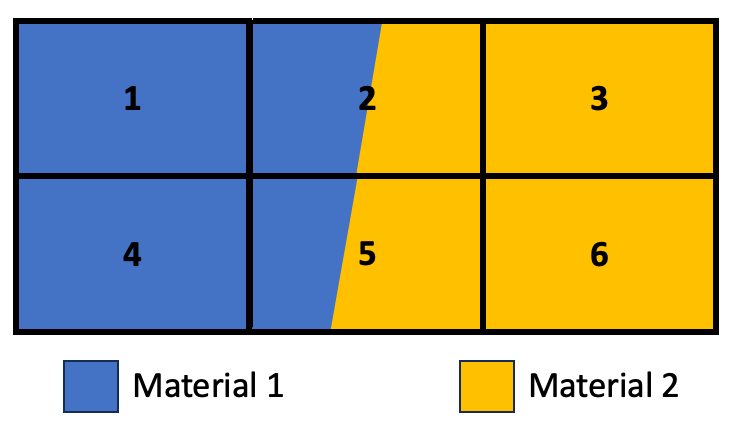 Figure 0-6a: Example of 2x3 mesh with two middle zones containing a mix of materials.
In this example, zones are numbered starting from 1 (instead of the default C-origin of 0).
Zones 2 and 5 are mixing, each in two materials (numbered 1 and 2).
Material numbers must be positive but can otherwise be arbitrary.
For example, the two materials here could have been numbered 37 and 2345.
Figure 0-6a: Example of 2x3 mesh with two middle zones containing a mix of materials.
In this example, zones are numbered starting from 1 (instead of the default C-origin of 0).
Zones 2 and 5 are mixing, each in two materials (numbered 1 and 2).
Material numbers must be positive but can otherwise be arbitrary.
For example, the two materials here could have been numbered 37 and 2345.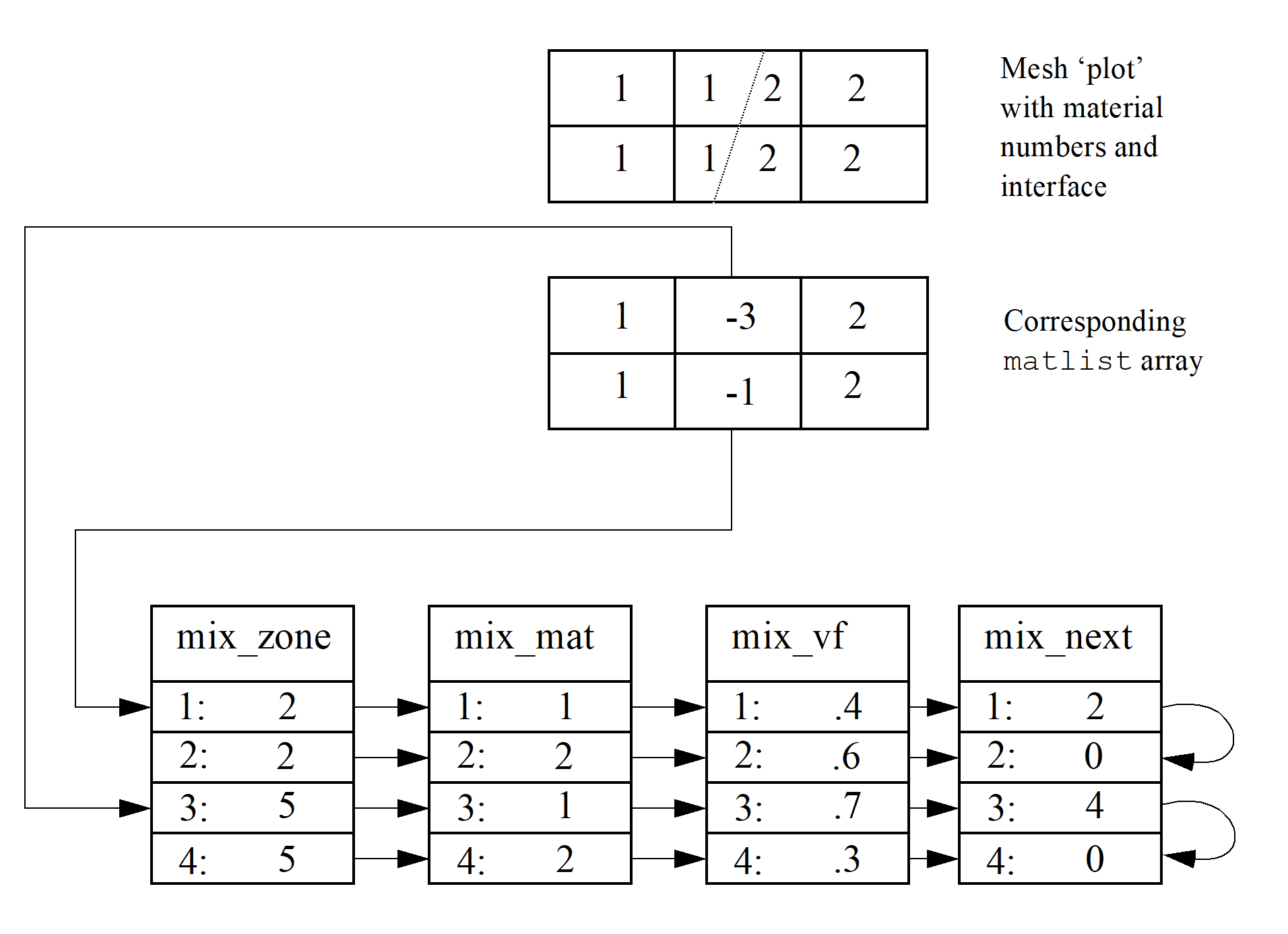 Figure 0-6b: Example using mixed data arrays for representing material information
DBGetMaterial()
Summary: Read material data from a Silo database.
C Signature:
DBmaterial *DBGetMaterial (DBfile *dbfile, char const *mat_name)
Fortran Signature:
NoneArguments:
Arg name
Description
dbfileDatabase file pointer.
mat_nameName of the material variable to read.
Returned value:
Returns a pointer to a
DBmaterialstructure on success andNULLon failure.Description:
The
DBGetMaterialfunction allocates aDBmaterialdata structure, reads material data from the Silo database, and returns a pointer to that structure. If an error occurs,NULLis returned.
DBPutMatspecies()
Summary: Write a material species data object into a Silo file.
C Signature:
int DBPutMatspecies (DBfile *dbfile, char const *name,
    char const *matname, int nmat, int const nmatspec[],
    int const speclist[], int const dims[], int ndims,
    int nspecies_mf, void const *species_mf, int const mix_spec[],
    int mixlen, int datatype, DBoptlist const *optlist)
Fortran Signature:
integer function dbputmsp(dbid, name, lname, matname,
   lmatname, nmat, nmatspec, speclist, dims, ndims,
   species_mf, species_mf, mix_spec, mixlen, datatype, optlist_id,
   status)

void *species_mf
Arguments:
Arg name
Description
dbfileDatabase file pointer.
nameName of the material species data object.
matnameName of the material object with which the material species object is associated.
nmatNumber of materials in the material object referenced by
matname.nmatspecArray of length
nmatcontaining the number of species associated with each material.speclistArray of dimension defined by
ndimsanddimsof indices into thespecies_mfarray. Each entry corresponds to one zone. If the zone is clean, the entry in this array must be positive or zero. A positive value is a 1-origin index into thespecies_mfarray. A zero can be used if the material in this zone contains only one species. If the zone is mixed, this value is negative and is used to index into themix_specarray in a manner analogous to the mix_mat array of theDBPutMaterial()call.dimsArray of length
ndimsthat defines the shape of thespeclistarray. To create an empty matspecies object, set every entry ofdimsto zero. See description below.ndimsNumber of dimensions in the
speclistarray.nspecies_mfLength of the
species_mfarray. To create a homogeneous matspecies object (which is not quite empty), setnspecies_mfto zero. See description below.species_mfArray of length
nspecies_mfcontaining mass fractions of the material species. Note, this can actually be either single or double precision. Specify type indatatypeargument.mix_specArray of length
mixlencontaining indices into thespecies_mfarray. These are used for mixed zones. For every index j in this array, mix_list[j] corresponds to theDBmaterialstructure’s material mix_mat[j] and zone mix_zone[j].mixlenLength of the
mix_specarray.datatypeThe
datatypeof the mass fraction data inspecies_mf. One of the predefined Silo data types.optlistPointer to an option list structure containing additional information to be included in the object written into the Silo file. Use a
NULLif there are no options.Returned value:
DBPutMatspecies returns zero on success and -1 on failure.
Description:
The
DBPutMatspeciesfunction writes a material species data object into a Silo file. The minimum required information for a material species data object is supplied via the standard arguments to this function. Theoptlistargument must be used for supplying any information not requested through the standard arguments.It is easiest to understand material species information by example. First, in order for a material species object in Silo to have meaning, it must be associated with a material object. A material species object by itself with no corresponding material object cannot be correctly interpreted.
So, suppose you had a problem which contains two materials, brass and steel. Now, neither brass nor steel are themselves pure elements on the periodic table. They are instead alloys of other (pure) metals. For example, common yellow brass is, nominally, a mixture of Copper (Cu) and Zinc (Zn) while tool steel is composed primarily of Iron (Fe) but mixed with some Carbon (C) and a variety of other elements.
For this example, lets suppose we are dealing with Brass (65% Cu, 35% Zn), T-1 Steel (76.3% Fe, 0.7% C, 18% W, 4% Cr,1% V) and O-1 Steel (96.2% Fe, 0.90% C,1.4% Mn, 0.50% Cr, 0.50% Ni, 0.50% W). Since T-1 Steel and O-1 Steel are composed of different elements, we wind up having to represent each type of steel as a different material in the material object. So, the material object would have 3 materials; Brass, T-1 Steel and O-1 Steel.
Brass is composed of 2 species, T-1 Steel, 5 species and O-1 Steel, 6. (Alternatively, one could opt to characterize both T-1 Steel and O-1 Steel has having 7 species, Fe, C, Mn, Cr, Ni, W, V where for T-1 Steel, the Mn and Ni components are always zero and for O-1 Steel the V component is always zero. In that case, you would need only 2 materials in the associated material object.)
The material species object would be defined such that nmat=3 and nmatspec={2,5,6}. If the composition of Brass, T-1 Steel and O-1 Steel is constant over the whole mesh, the
species_mfarray would contain just 2 + 5 + 6 = 13 entries…
|
|
|
|
|
|
|
|
|
|
|
|
|
|
|||||||||||||
|---|---|---|---|---|---|---|---|---|---|---|---|---|---|---|---|---|---|---|---|---|---|---|---|---|---|---|
| Brass | T1 Steel | O1 Steel | |||||||||||||||||||||||
|
.65 |
.35 |
.763 |
.007 |
.18 |
.04 |
.001 |
.962 |
.009 |
.014 |
.005 |
.005 |
.005 |
|||||||||||||
element |
Cu |
Zn |
Fe |
C |
W |
Cr |
V |
Fe |
C |
Mn |
Cr |
Ni |
W |
|||||||||||||
index |
1 |
2 |
3 |
4 |
5 |
6 |
7 |
8 |
9 |
10 |
11 |
12 |
13 |
|||||||||||||
If all of the zones in the mesh are clean (e.g. not mixing in material) and have the same composition of species, the speclist array would contain a 1 for every Brass zone (1-origin indexing would mean it would index species_mf[0]), a 3 for every T-1 Steel zone and a 8 for every O-1 Steel zone.
However, if some cells had a Brass mixture with an extra 1% Cu, then you could create another two entries at positions 14 and 15 in the species_mf array with the values 0.66 and 0.34, respectively, and the speclist array for those cells would point to 14 instead of 1.
The speclist entries indicate only where to start reading species mass fractions from the species_mf array for a given zone.
How do we know how many values to read?
The associated material object indicates which material is in the zone.
The entry in the nmatspec array for that material indicates how many mass fractions there are.
As simulations evolve, the relative mass fractions of species comprising each material vary away from their nominal values.
In this case, the species_mf array would grow to accommodate all the variations of combinations of mass fraction for each material and the entries in the speclist array would vary so that each zone would index the correct position in the species_mf array.
Finally, when zones contain mixing materials the speclist array needs to specify the species_mf entries for each of the materials in the zone.
In this case, negative values are assigned to the speclist entries for these zones and the linked-list like structure of the associated material (e.g. mix_next, mix_mat, mix_vf, mix_zone args of the DBPutMaterial() call) is used to traverse them.
To create a completely empty matspecies object, the caller needs to pass a dims array containing all zeros.
In this case, the speclist and mix_speclist args are never dereferenced and no data for these are written to the file or returned by a subsequent DBGetMatspecies() call.
Alternatively, the caller may have what amounts to an empty species object due to nspecies_mf==0.
However, in that situation, the caller is unfortunately still required to pass fully populated speclist and, if mixing is involved, mix_speclist arrays.
Worse, the only valid values in these arrays are zeros.
In this case, the resulting matspecies object isn’t so much empty as it is homogeneous in that all materials consist of only a single species.
The following table describes the options accepted by this function:
Option Name |
Value Data Type |
Option Meaning |
Default Value |
|---|---|---|---|
|
|
Indicator for row-major (0) or column-major (1) storage for multidimensional arrays. |
0 |
|
|
Origin for arrays. Zero or one. |
0 |
|
|
Specify a non-zero value if you do not want this object to appear in menus of downstream tools |
0 |
|
|
Array of strings defining the names of the individual species. The length of this array is the sum of the values in the |
|
|
|
Array of strings defining the names of colors to be associated with each species. The color names are taken from the X windows color database. If a color |
|
DBGetMatspecies()
Summary: Read material species data from a Silo database.
C Signature:
DBmatspecies *DBGetMatspecies (DBfile *dbfile,
    char const *ms_name)
Fortran Signature:
NoneArguments:
Arg name
Description
dbfileDatabase file pointer.
ms_nameName of the material species data to read.
Returned value:
Returns a pointer to a
DBmatspeciesstructure on success andNULLon failure.Description:
The
DBGetMatspeciesfunction allocates aDBmatspeciesdata structure, reads material species data from the Silo database, and returns a pointer to that structure. If an error occurs,NULLis returned.
DBPutDefvars()
Summary: Write a derived variable definition(s) object into a Silo file.
C Signature:
int DBPutDefvars(DBfile *dbfile, const char *name, int ndefs,
    const char * const names[], int const *types,
    const char * const defns[], DBoptlist cost *optlist[]);
Fortran Signature:
integer function dbputdefvars(dbid, name, lname, ndefs,
   names, lnames, types, defns, ldefns, optlist_id,
   status)
character*N names(Seedbset2dstrlen)character*N defns(Seedbset2dstrlen)Arguments:
Arg name
Description
dbfileDatabase file pointer.
nameName of the derived variable definition(s) object.
ndefsnumber of derived variable definitions.
namesArray of length
ndefsof derived variable namestypesArray of length
ndefsof derived variable typesdefnsArray of length
ndefsof derived variable definitions.optlistArray of length
ndefspointers to option list structures containing additional information to be included with each derived variable. The options available are the same as those available for the respective variables.Returned value:
Returns zero on success and -1 on failure.
Description:
The
DBPutDefvarsfunction is used to put definitions of derived variables in the Silo file. That is variables that are derived from other variables in the Silo file or other derived variable definitions. One or more variable definitions can be written with this function. Note that only the definitions of the derived variables are written to the file with this call. The variables themselves are not in any way computed by Silo.If variable references within the
defnsstrings do not have a leading slash (‘/’) (indicating an absolute name), they are interpreted relative to the directory into which the Defvars object is written. For thedefnsstring, in cases where a variable’snameincludes special characters (such as/ . { } [ ] + - = ), the entire variable reference should be bracketed by<and>characters.The interpretation of the
defnsstrings written here is determined by the post-processing tool that reads and interprets these definitions. Since in common practice that tool tends to be VisIt, the discussion that follows describes how VisIt would interpret this string.The table below illustrates examples of the contents of the various array arguments to
DBPutDefvarsfor a case that defines 6 derived variables.names
types
defns
“totaltemp”
DB_VARTYPE_SCALAR"nodet+zonetemp"“<stress/sz>”
DB_VARTYPE_SCALAR"-<stress/sx>-<stress/sy>"“vel”
DB_VARTYPE_VECTOR"{Vx, Vy, Vz}"“speed”
DB_VARTYPE_SCALAR"magntidue(vel)"“dev_stress”
DB_VARTYPE_TENSOR"{ {<stress/sx>,<stress/txy>,<stress/txz>},{ 0, <stress/sy>,<stress/tyz>},{ 0, 0, <stress/sz>} }"The first entry (0) defines a derived scalar variable named
"totaltemp"which is the sum of variables whose names are"nodet"and"zonetemp". The next entry (1) defines a derived scalar variable named"sz"in a group of variables named"stress"(the slash character (‘/’) is used to group variable names much the way file pathnames are grouped in Linux). Note also that the definition of"sz"uses the special bracketing characters (<) and (>) for the variable references due to the fact that these variable references have a slash character (/) in them.The third entry (2) defines a derived vector variable named
"vel"from three scalar variables named"Vx","Vy", and"Vz"while the fourth entry (3) defines a scalar variable,"speed"to be the magnitude of the vector variable named"vel". The last entry (4) defines a deviatoric stress tensor. These last two cases demonstrate that derived variable definitions may reference other derived variables.The last few examples demonstrate the use of two operators,
{}, andmagnitude(). We call these expression operators. In VisIt, there are numerous expression operators to help define derived variables including such things assqrt(),round(),abs(),cos(),sin(),dot(),cross()as well as comparison operators,gt(),ge(),lt(),le(),eq(), and the conditionalif(). Furthermore, the list of expression operators in VisIt grows regularly. Only a few examples are illustrated here. For a more complete list of the available expression operators and their syntax, the reader is referred to the Expressions portion of the VisIt user’s manual.
DBGetDefvars()
Summary: Get a derived variables definition object from a Silo file.
C Signature:
DBdefvars DBGetDefvars(DBfile *dbfile, char const *name)
Fortran Signature:
NoneArguments:
Arg name
Description
dbfileDatabase file pointer.
nameThe
nameof theDBdefvarsobject to readReturned value:
Returns a pointer to a
DBdefvarsstructure on success andNULLon failure.Description:
The
DBGetDefvarsfunction allocates aDBdefvarsdata structure, reads the object from the Silo database, and returns a pointer to that structure. If an error occurs,NULLis returned.
int DBInqMeshname (DBfile *dbfile, char const *varname, char *meshname)
* **Fortran Signature:**
None
* **Arguments:**

Arg name | Description
:---|:---
`dbfile` | Database file pointer.
`varname` | Variable name.
`meshname` | Returned mesh name. The caller must allocate space for the returned name. The maximum space used is `256` characters, including the `NULL` terminator.

* **Returned value:**

`DBInqMeshname` returns zero on success and -1 on failure.

* **Description:**

The `DBInqMeshname` function returns the name of a mesh associated with a mesh variable.
Given the name of a variable to access, one must call this function to find the name of the mesh before calling `DBGetQuadmesh` or `DBGetUcdmesh`.

{{ EndFunc }}

## `DBInqMeshtype()`

* **Summary:** Inquire the mesh type of a mesh.

* **C Signature:**
int DBInqMeshtype (DBfile *dbfile, char const *meshname)
* **Fortran Signature:**
None
* **Arguments:**

Arg name | Description
:---|:---
`dbfile` | Database file pointer.
`meshname` | Mesh name.

* **Returned value:**

`DBInqMeshtype` returns the mesh type on success and -1 on failure.

* **Description:**

The `DBInqMeshtype` function returns the type of the given mesh.
The value returned is described in the following table:

Mesh Type|Returned Value
:---|:---
Multi-Block|`DB_MULTIMESH`
UCD|`DB_UCDMESH`
Pointmesh|`DB_POINTMESH`
Quad (Collinear)|`DB_QUAD_RECT`
Quad (Non-Collinear)|`DB_QUAD_CURV`
CSG|`DB_CSGMESH`

{{ EndFunc }}