Multi-Block Objects and Parallel I/O
Individual pieces of mesh created with a number of DBPutXxxmesh() calls can be assembled together into larger, multi-block objects.
Likewise for variables and materials defined on these meshes.
In Silo, multi-block objects are really just lists of all the individual pieces of a larger, coherent object.
For example, a multi-mesh object is really just a long list of object names, each name being the string passed as the name argument to a DBPutXxxmesh() call.
A key feature of multi-block object is that references to the individual pieces include the option of specifying the name of the Silo file in which a piece is stored.
This option is invoked when the colon operator (:) appears in the name of an individual piece.
All characters before the colon specify the name of a Silo file in the host file system.
All characters after a colon specify a directory path within the Silo file where the object lives.
The fact that multi-block objects can reference individual pieces that reside in different Silo files means that Silo, a serial I/O library, can be used very effectively and scalably in parallel without resorting to writing a file per processor. The technique used to affect parallel I/O in this manner with Silo is Multiple Independent File Parallel I/O.
A separate convenience interface, PMPIO, is provided for this purpose.
The PMPIO interface provides almost all of the functionality necessary to use Silo in the MIF paradigm.
The application is required to implement a few callback functions.
The PMPIO interface is described at the end of this section.
The functions described in this section of the manual include…
DBPutMultimesh()
Summary: Write a multi-block mesh object into a Silo file.
C Signature:
int DBPutMultimesh (DBfile *dbfile, char const *name, int nmesh,
    char const * const meshnames[], int const meshtypes[],
    DBoptlist const *optlist)
Fortran Signature:
integer function dbputmmesh(dbid, name, lname, nmesh,
   meshnames, lmeshnames, meshtypes, optlist_id, status)
character*N meshnames(Seedbset2dstrlen.)Arguments:
Arg name
Description
dbfileDatabase file pointer.
nameName of the multi-block mesh object.
nmeshNumber of meshes pieces (blocks) in this multi-block object.
meshnamesArray of length
nmeshcontaining pointers to the names of each of the mesh blocks written with aDBPutXxxmesh()call. See below for description of how to populatemeshnameswhen the pieces are in different files as well asDBOPT_MB_FILE_NSandDBOPT_MB_BLOCK_NSoptions to use a printf-style namescheme for largenmeshin lieu of explicitly enumerating them here.meshtypesArray of length
nmeshcontaining the type of each mesh block such asDB_QUAD_RECT,DB_QUAD_CURV,DB_UCDMESH,DB_POINTMESH, andDB_CSGMESH. Be sure to see description, below, forDBOPT_MB_BLOCK_TYPEoption to use single, constant value when all pieces are the same type.optlistPointer to an option list structure containing additional information to be included in the object written into the Silo file. Use a
NULLif there are no options.Returned value:
DBPutMultimesh returns zero on success and -1 on failure.
Description:
The
DBPutMultimeshfunction writes a multi-block mesh object into a Silo file. It accepts as input the names of the various sub-meshes (blocks) which are part of this mesh.The mesh blocks may be stored in different sub-directories within a Silo file and, optionally, even in different Silo files altogether. So, the
nameof each mesh block is specified using its full Silo pathname. The full Silo path name is the form…[<silo-filename>:]<path-to-mesh>
The existence of a colon (‘:’) anywhere in meshnames[i] indicates that the ith mesh block
nameis specified using both the Silo filename and the path in the file. All characters before the colon are the Silo file path name within the file system on which the file(s) reside. Use whatever slash character (’’ for Windows or ‘/’ for Unix) is appropriate for the underlying file system in this part of the string only. Silo will automatically handle changes in the slash character in this part of the string if this data is ever read on a different file system. All characters after the colon are the path of the object within the Silo file and must use only the ‘/’ slash character.Use the keyword “EMPTY” for any block for which the associated mesh object does not exist. This convention is often convenient in cases where there are many related multi-block objects and/or that evolve in time in such a way that some blocks do not exist for some times.
The individual mesh names referenced here
CANNOTbe the names of other multi-block meshes. In other words, it is not valid to create a multi-mesh that references other multi-meshes.For example, in the case where the are 6 blocks to be assembled into a larger mesh named ‘multi-mesh’ in the file ‘foo.silo’ and the blocks are stored in three files as in the figure below,
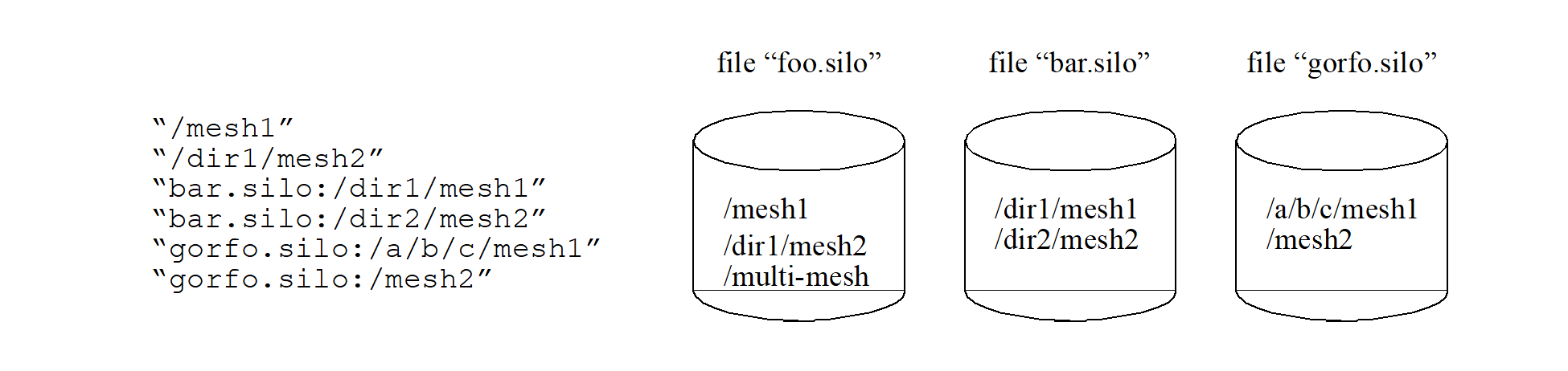 Figure 0-7: Strings for multi-block objects.
the array of strings to be passed as the
meshnamesargument ofDBPutMultimeshare illustrated. Note that the two pieces of mesh that are in the same file as the multi-mesh object itself, ‘multi-mesh’, do not require the colon and filename option. Only those pieces of the multi-mesh object that are in different files from the one the multi-block object itself resides in require the colon and filename option.You may pass
NULLfor themeshnamesargument and instead use the namescheme options,DBOPT_MB_FILE_NSandDBOPT_MB_BLOCK_NSdescribed in the table of options, below. This is particularly important for meshes consisting of O(105) or more blocks because it saves substantial memory and I/O time. SeeDBMakeNameschemefor how to specify nameschemes.Note, however, that with the
DBOPT_MB_FILE|BLOCK_NSoptions, you are specifying only the string that a reader will later use in a call toDBMakeNamescheme()to create a namescheme object suitable for generating themeshnamesand not the namescheme object itself.For convenience, two namescheme options are supported. One namescheme maps block numbers to filenames. The other maps block numbers to object names. A reader is required to then combine both to generate the complete block
namefor each mesh block. Optionally and where appropriate, one can specify a block namescheme only. External array references may be used in the nameschemes. Any such array names found in the namescheme are assumed to be the names of simple, 1D, integer arrays written with aDBWrite()call and existing in the same directory as the multi-block object . Finally, keep in mind that in the nameschemes, blocks are numbered starting from zero.If you are using the namescheme options and have
EMPTYblocks, since themeshnamesargument isNULL, you can use theDBOPT_MB_EMPTY_COUNT|LISToptions to explicitly enumerate any empty blocks instead of having to incorporate them into your nameschemes.Similarly, when the mesh consists of blocks of all the same type, you may pass
NULLfor themeshtypesargument and instead use theDBOPT_MB_BLOCK_TYPEoption to specify a single, constant block type for all blocks. This option can result in important savings for large numbers of blocks.Finally, note that what is described here for the multimesh object in the way of
namefor the individual blocks applies to all multi-block objects (e.g.DBPutMultixxx).Notes:
The following table describes the options accepted by this function:
Optlist options:
Option Name
Value Data Type
Option Meaning
Default Value
DBOPT_BLOCKORIGINintThe origin of the block numbers.
1
DBOPT_CYCLEintProblem cycle value.
0
DBOPT_TIMEfloatProblem time value.
0.0
DBOPT_DTIMEdoubleProblem time value.
0.0
DBOPT_EXTENTS_SIZEintNumber of values in each extent tuple
0
DBOPT_EXTENTSdouble*Pointer to an array of length
nmesh*DBOPT_EXTENTS_SIZEdoubles where each group ofDBOPT_EXTENTS_SIZEdoubles is an extent tuple for the mesh coordinates (see below).DBOPT_EXTENTS_SIZEmust be set for this option to work correctly.NULLDBOPT_ZONECOUNTSint*Pointer to an array of length
nmeshindicating the number of zones in each block.NULLDBOPT_HAS_EXTERNAL_ZONESint*Pointer to an array of length
nmeshindicating for each block whether that block has zones external to the whole multi-mesh object. A non-zero value at index i indicates block i has external zones. A value of 0 (zero) indicates it does not.NULLDBOPT_HIDE_FROM_GUIintSpecify a non-zero value if you do not want this object to appear in menus of downstream tools
0
DBOPT_MRGTREE_NAMEchar*Name of the mesh region grouping tree to be associated with this multimesh.
NULLDBOPT_TV_CONNECTIVTYintA non-zero value indicates that the connectivity of the mesh varies with time.
0
DBOPT_DISJOINT_MODEintIndicates if any elements in the mesh are disjoint. There are two possible modes. One is
DB_ABUTTINGindicating that elements abut spatially but actually reference different node ids (but spatially equivalent nodal positions) in the node list. The other isDB_FLOATINGwhere elements neither share nodes in the nodelist nor abut spatially.DB_NONEDBOPT_TOPO_DIMintUsed to indicate the topological dimension of the mesh apart from its spatial dimension.
-1 (not specified)
DBOPT_MB_BLOCK_TYPEintConstant block type for all blocks
(not specified)
DBOPT_MB_FILE_NSchar*Multi-block file namescheme. This is a namescheme, indexed by block number, to generate filename in which each block is stored.
NULLDBOPT_MB_BLOCK_NSchar*Multi-block block namescheme. This is a namescheme, indexed by block number, used to generate names of each block object apart from the file in which it may reside.
NULLDBOPT_MB_EMPTY_LISTint*When namescheme options are used, there is no
meshnamesargument in which to use the keyword ‘EMPTY’ for empty blocks. Instead, the empty blocks can be enumerated here, indexed from zero.NULLDBOPT_MB_EMPTY_COUNTintNumber of entries in the argument to
DBOPT_MB_EMPTY_LIST0
The options specified below have been deprecated. Use Mesh Region Group (MRG) trees instead.
DBOPT_GROUPORIGINintThe origin of the group numbers.
1
DBOPT_NGROUPSintThe total number of groups in this multimesh object.
0
DBOPT_ADJACENCY_NAMEchar*Name of a multi-mesh, nodal adjacency object written with a call to adj.
NULLDBOPT_GROUPINGS_SIZEintNumber of integer entries in the associated groupings array
0
DBOPT_GROUPINGSint*Integer array of length specified by
DBOPT_GROUPINGS_SIZEcontaining information on how different mesh blocks are organized into, possibly hierarchical, groups. See below for detailed discussion.NULLDBOPT_GROUPINGS_NAMESchar**Optional set of names to be associated with each group in the groupings array
NULLThere is a class of options for multiblock objects that is very important in helping to accelerate performance in down-stream post-processing tools. We call these Downstream Performance Options. In order of utility, these options are
DBOPT_EXTENTS,DBOPT_MIXLENSandDBOPT_MATLISTSandDBOPT_ZONECOUNTS. Although these options are creating redundant data in the Silo database, the data is stored in a manner that is far more convenient to down-stream applications that read Silo databases. Therefore, the user is strongly encouraged to make use of these options.Regarding the
DBOPT_EXTENTSoption, see the notes forDBPutMultivar. Note, however, that here the extents are for the coordinates of the mesh.Regarding the
DBOPT_ZONECOUNTSoption, this option will help down-stream post-processing tools to select an appropriate static load balance of blocks to processors.Regarding the
DBOPT_HAS_EXTERNAL_ZONESoption, this option will help down-stream post-processing tools accelerate computation of external boundaries. When a block is known not to contain any external zones, it can be quickly skipped in the computation. Note that while false positives can negatively effect only performance during downstream external boundary calculations, false negatives will result in serious errors.In other words, it is ok for a block that does not have external zones to be flagged as though it does. In this case, all that will happen in down-stream post-processing tools is that work to compute external faces that could have been avoided will be wasted. However, it is not ok for a block that has external zones to be flagged as though it does not. In this case, down-stream post-processing tools will skip boundary computation when it should have been computed.
Three options,
DBOPT_GROUPINGS_SIZE,DBOPT_GROUPINGSare deprecated. Instead, use MRG trees to handle grouping. Also, see notes regarding_visit_domain_groupsvariable convention.
DBGetMultimesh()
Summary: Read a multi-block mesh from a Silo database.
C Signature:
DBmultimesh *DBGetMultimesh (DBfile *dbfile, char const *meshname)
Fortran Signature:
NoneArguments:
Arg name
Description
dbfileDatabase file pointer.
meshnameName of the multi-block mesh.
Returned value:
Returns a pointer to a
DBmultimeshstructure on success andNULLon failure.Description:
The
DBGetMultimeshfunction allocates aDBmultimeshdata structure, reads a multi-block mesh from the Silo database, and returns a pointer to that structure. If an error occurs,NULLis returned.
DBPutMultimeshadj()
Summary: Write some or all of a multi-mesh adjacency object into a Silo file.
C Signature:
int DBPutMultimeshadj(DBfile *dbfile, char const *name,
    int nmesh, int const *mesh_types, int const *nneighbors,
    int const *neighbors, int const *back,
    int const *nnodes, int const * const nodelists[],
    int const *nzones, int const * const zonelists[],
    DBoptlist const *optlist)
Fortran Signature:
NoneArguments:
Arg name
Description
dbfileDatabase file pointer.
nameName of the multi-mesh adjacency object.
nmeshThe number of mesh pieces in the corresponding multi-mesh object. This value must be identical in repeated calls to
DBPutMultimeshadj.mesh_typesInteger array of length
nmeshindicating the type of each mesh in the corresponding multi-mesh object. This array must be identical to that which is passed in theDBPutMultimeshcall and in repeated calls toDBPutMultimeshadj.nneighborsInteger array of length
nmeshindicating the number ofneighborsfor each mesh piece. This array must be identical in repeated calls toDBPutMultimeshadj. In the argument descriptions to follow, let \(S_k = \sum_{i=1}^k \text{nneighbors}[i]\), which sums the firstkelements from thenneighborsarray.neighborsArray of \(S_{\text{nmesh}}\) integers enumerating for each mesh piece all other mesh pieces that neighbor it. Entries from index \(S_k\) to index \(S_{k+1}-1\) enumerate the
neighborsof mesh piecek. This array must be identical in repeated calls toDBPutMultimeshadj.backArray of \(S_{\text{nmesh}}\) integers enumerating for each mesh piece, the local index of that mesh piece in each of its
neighborslists ofneighbors. Entries from index \(S_k\) to index \(S_{k+1}-1\) enumerate the local indices of mesh piecekin each of theneighborsof mesh piecek. This argument may beNULL. In any case, this array must be identical in repeated calls toDBPutMultimeshadj.nnodesArray of \(S_{\text{nmesh}}\) integers indicating for each mesh piece, the number of nodes that it shares with each of its
neighbors. Entries from index \(S_k\) to index \(S_{k+1}-1\) indicate the number of nodes that mesh piece k shares with each of itsneighbors. This array must be identical in repeated calls toDBPutMultimeshadj. This argument may beNULL.nodelistsArray of \(S_{\text{nmesh}}\) pointers to arrays of integers. Entries from index \(S_k\) to index \(S_{k+1}-1\) enumerate the nodes that mesh piece
kshares with each of itsneighbors. The contents of a specific nodelist array depend on the types of meshes that are neighboring each other (See description below).nodelists[m]may beNULLeven ifnnodes[m]is non-zero. See below for a description of repeated calls toDBPutMultimeshadj. This argument must beNULLifnnodesisNULL.nzonesArray of \(S_{\text{nmesh}}\) integers indicating for each mesh piece, the number of zones that are adjacent with each of its
neighbors. Entries from index \(S_k\) to index \(S_{k+1}-1\) indicate the number of zones that mesh piecekhas adjacent to each of itsneighbors. This array must be identical in repeated calls toDBPutMultimeshadj. This argument may beNULL.zonelistsArray of \(S_{\text{nmesh}}\) pointers to arrays of integers. Entries from index \(S_k\) to index \(S_{k+1}-1\) enumerate the zones that mesh piece
khas adjacent with each of itsneighbors. The contents of a specific zonelist array depend on the types of meshes that are neighboring each other (See description below).zonelists[m]may beNULLeven ifnzones[m]is non-zero. See below for a description of repeated calls toDBPutMultimeshadj. This argument must beNULLifnzonesisNULL.optlistPointer to an option list structure containing additional information to be included in the object written into the Silo file. Use a
NULLif there are no options.Description:
Note: This object suffers from scalability issues above about 10{sup}5 blocks.
The functionality this object provides is now more efficiently and conveniently handled via Mesh Region Grouping (MRG) trees. Users are encouraged to use MRG trees as an alternative to
DBPutMultimeshadj(). SeeDBMakeMrgtree.DBPutMultimeshadjis another down-stream performance option (SeeDBPutMultimesh). It is an alternative to including ghost-zones (SeeDBPutMultimesh) in the mesh and may help to reduce file size, particularly for unstructured meshes.A multi-mesh adjacency object informs down-stream, post-processing tools such as VisIt how nodes and/or zones, should be shared between neighboring mesh blocks of a multi-block mesh to eliminate post-processing discontinuity artifacts along the boundaries between the pieces. If neither this information is provided nor ghost zones are stored in the file, post-processing tools must then infer this information from global node or zone ids (if they exist) or, worse, by matching coordinates which is a time-consuming and unreliable process.
DBPutMultimeshadjis used to indicate how various mesh pieces in a multi-mesh object abut by specifying for each mesh piece, the nodes it shares with other mesh pieces and/or the zones is has adjacent to other mesh pieces. Note the important distinction in how nodes and zones are classified here. Nodes are shared between mesh pieces while zones are merely adjacent between mesh pieces. In a call to DBPutMultimeshadj, a caller may write information for either shared nodes or adjacent zones, or both.In practice, applications tend to use the same mesh type for every mesh piece. Thus, for ucd and point meshes, the nodelist (or zonelist) arrays will consists of pairs of integers where the first of the pair identifies a node (or zone) in the given mesh while the second identifies the shared node (or adjacent zone) in a neighbor. Likewise, for quad meshes, the nodelist (or zonelist) arrays will consists of 15 integers the first 6 of which identify a slab of nodes (or zones) in the given quad mesh. The second set of 6 integers identify the slab of shared nodes (or zones) in a neighbor quad mesh and the last 3 integers indicate the orientation of the neighbor quad mesh relative to the given quad mesh. For example the entries (1,2,3) for these 3 integers mean that all axes are aligned. The entries (-2,1,3) mean that the -J axis of the neighbor mesh piece aligns with the +I axis of the given mesh piece, the +I axis of the neighbor mesh piece aligns with the +J axis of the given mesh piece, and the +K axes both align the same way.
The specific contents of a given nodelist array depend on the types of meshes between which it enumerates shared nodes. The table below describes the contents of nodelist array m given the different mesh types that it may enumerate shared nodes for.
DB_POINTorDB_UCDDB_QUADDB_POINT
orDB_UCDnnodes[m]pairs of integersnnodes[m]+6integers
The firstnnodes[m]integers identify the nodes in the given point or ucd mesh block.
The next 6 integers identify ijk bounds of the corresponding nodes in the quad mesh neighbor block.DB_QUAD6+nnodes[m]integers.
The first 6 integers identify ijk bounds of the nodes in the given quad mesh block.
The lastnnodes[m]integers identify the nodes in the neighbor point or ucd mesh block.15 integers
The first set of 6 integers identify ijk bounds of nodes in the given quad mesh block.
The second set of 6 integers identify ijk bounds of nodes in the neighbor quad mesh block.
The next 3 integers specify the orientation of the neighbor quad mesh block relative to the given mesh block.This function is designed so that it may be called multiple times, each time writing a different portion of multi-mesh adjacency information to the object. On the first call, space is allocated in the Silo file for the entire object. The required space is determined by the contents of all but the
nodelists(and/or zonelists) arrays. The contents of thenodelists(and/or zonelists) arrays are the only arguments that are permitted to vary from call to call and then they may vary only in which entries areNULLand non-NULL. Whenever an entry isNULLand the corresponding entry innnodes(or nzones) array is non-zero, the assumption is that the information is provided in some other call toDBPutMultimeshadj.
DBGetMultimeshadj()
Summary: Get some or all of a multi-mesh nodal adjacency object
C Signature:
DBmultimeshadj *DBGetMultimeshadj(DBfile *dbfile,
    char const *name,
    int nmesh, int const *mesh_pieces)
Fortran Signature:
NoneArguments:
Arg name
Description
dbfileDatabase file pointer
nameName of the multi-mesh nodal adjacency object
nmeshNumber of mesh pieces for which nodal adjacency information is being obtained. Pass zero if you want to obtain all nodal adjacency information in a single call.
mesh_piecesInteger array of length
nmeshindicating which mesh pieces nodal adjacency information is desired for. May passNULLifnmeshis zero.Returned value:
A pointer to a fully or partially populated
DBmultimeshadjobject orNULLon failure.Description:
DBGetMultimeshadjreturns a nodal adjacency object. This function is designed so that it may be called multiple times to obtain information for different mesh pieces in different calls. Thenmeshandmesh_piecesarguments permit the caller to specify for which mesh pieces adjacency information shall be obtained.
DBPutMultivar()
Summary: Write a multi-block variable object into a Silo file.
C Signature:
int DBPutMultivar (DBfile *dbfile, char const *name, int nvar,
    char const * const varnames[], int const vartypes[],
    DBoptlist const *optlist);
Fortran Signature:
integer function dbputmvar(dbid, name, lname, nvar,
   varnames, lvarnames, vartypes, optlist_id, status)
character*N varnames(Seedbset2dstrlen.)Arguments:
Arg name
Description
dbfileDatabase file pointer.
nameName of the multi-block variable.
nvarNumber of variables associated with the multi-block variable.
varnamesArray of length
nvarcontaining pointers to the names of the variables written withDBPutXxxvar()call. SeeDBPutMultimeshfor description of how to populatevarnameswhen the pieces are in different files as well as `DBOPT_MB_BLOCKvartypesArray of length
nvarcontaining the types of the variables such asDB_POINTVAR,DB_QUADVAR, orDB_UCDVAR. SeeDBPutMultimesh, forDBOPT_MB_BLOCK_TYPEoption to use single, constant value when all pieces are the same type.optlistPointer to an option list structure containing additional information to be included in the object written into the Silo file. Use a
NULLif there are no options.Returned value:
DBPutMultivar returns zero on success and -1 on failure.
Description:
The
DBPutMultivarfunction writes a multi-block variable object into a Silo file.Notes:
The following table describes the options accepted by this function:
Optlist options:
Option Name
Value Data Type
Option Meaning
Default Value
DBOPT_BLOCKORIGINintThe origin of the block numbers.
1
DBOPT_CYCLEintProblem cycle value.
0
DBOPT_TIMEfloatProblem time value.
0.0
DBOPT_DTIMEdoubleProblem time value.
0.0
DBOPT_HIDE_FROM_GUIintSpecify a non-zero value if you do not want this object to appear in menus of downstream tools
0
DBOPT_EXTENTS_SIZEintNumber of values in each extent tuple
0
DBOPT_EXTENTSdouble*Pointer to an array of length
nvar*DBOPT_EXTENTS_SIZEdoubles where each group ofDBOPT_EXTENTS_SIZEdoubles is an extent tuple (see below).DBOPT_EXTENTS_SIZEmust be set for this option to work correctly.NULLDBOPT_MMESH_NAMEchar*Name of the multimesh this variable is associated with. Note, this option is very important as down-stream post processing tools are otherwise required to guess as to the mesh a given variable is associated with. Sometimes, the tools can guess wrong.
NULLDBOPT_TENSOR_RANKintSpecify the variable type; one of either
DB_VARTYPE_SCALAR,DB_VARTYPE_VECTORDB_VARTYPE_TENSOR,DB_VARTYPE_SYMTENSOR,DB_VARTYPE_ARRAYDB_VARTYPE_LABELDB_VARTYPE_SCALAR
DBOPT_REGION_PNAMESchar**A null-pointer terminated array of pointers to strings specifying the pathnames of regions in the mrg tree for the associated mesh where the variable is defined. If there is no mrg tree associated with the mesh, the names specified here will be assumed to be material names of the material object associated with the mesh. The last pointer in the array must be null and is used to indicate the end of the list of names. See
DBOPT_REGION_PNAMES.NULLDBOPT_CONSERVEDintIndicates if the variable represents a physical quantity that must be conserved under various operations such as interpolation.
0
DBOPT_EXTENSIVEintIndicates if the variable represents a physical quantity that is extensive (as opposed to intensive). Note, while it is true that any conserved quantity is extensive, the converse is not true. By default and historically, all Silo variables are treated as intensive.
0
DBOPT_MB_BLOCK_TYPEintConstant block type for all blocks
(not specified)
DBOPT_MB_FILE_NSchar*Multi-block file namescheme. This is a namescheme, indexed by block number, to generate filename in which each block is stored.
NULLDBOPT_MB_BLOCK_NSchar*Multi-block block namescheme. This is a namescheme, indexed by block number, used to generate names of each block object apart from the file in which it may reside.
NULLDBOPT_MB_EMPTY_LISTint*When namescheme options are used, there is no
varnamesargument in which to use the keyword ‘EMPTY’ for empty blocks. Instead, the empty blocks can be enumerated here, indexed from zero.NULLDBOPT_MB_EMPTY_COUNTintNumber of entries in the argument to
DBOPT_MB_EMPTY_LIST0
DBOPT_MISSING_VALUEdoubleSpecify a numerical value that is intended to represent “missing values” in the x or y data arrays. Default is
DB_MISSING_VALUE_NOT_SETDB_MISSING_VALUE_NOT_SET
The options below have been deprecated. Use MRG trees instead.
DBOPT_GROUPORIGINintThe origin of the group numbers.
1
DBOPT_NGROUPSintThe total number of groups in this multimesh object.
0
Regarding the
DBOPT_EXTENTSoption, an extent tuple is a tuple of the variable’s minimum value(s) followed by the variable’s maximum value(s). If the variable is a single, scalar variable, each extent tuple will be 2 values of the form {min,max}. Thus,DBOPT_EXTENTS_SIZEwill be 2. If the variable consists of nvars subvariables (e.g. the nvars argument in any of DBPutPointvar, DBPutQuadvar,DBPutUcdvaris greater than 1), then each extent tuple is 2nvars values of each subvariable’s minimum value followed by each subvariable’s maximum value. In this case,DBOPT_EXTENTS_SIZEwill be 2nvars.For example, if we have a multi-var object of a 3D velocity vector on 2 blocks, then
DBOPT_EXTENTS_SIZEwill be 23=6 and theDBOPT_EXTENTSarray will be an array of 26 doubles organized as follows…{Vx_min_0, Vy_min_0, Vz_min_0, Vx_max_0, Vy_max_0, Vz_max_0,
Vx_min_1, Vy_min_1, Vz_min_1, Vx_max_1, Vy_max_1, Vz_max_1}
Note that if ghost zones are present in a block, the extents must be computed such that they include contributions from data in the ghost zones. On the other hand, if a variable has mixed components, that is component values on materials mixing within zones, then the extents should not include contributions from the mixed variable values.
DBGetMultivar()
Summary: Read a multi-block variable definition from a Silo database.
C Signature:
DBmultivar *DBGetMultivar (DBfile *dbfile, char const *varname)
Fortran Signature:
NoneArguments:
Arg name
Description
dbfileDatabase file pointer.
varnameName of the multi-block variable.
Returned value:
DBGetMultivar returns a pointer to a
DBmultivarstructure on success andNULLon failure.Description:
The
DBGetMultivarfunction allocates aDBmultivardata structure, reads a multi-block variable from the Silo database, and returns a pointer to that structure. If an error occurs,NULLis returned.
DBPutMultimat()
Summary: Write a multi-block material object into a Silo file.
C Signature:
int DBPutMultimat (DBfile *dbfile, char const *name, int nmat,
    char const * const matnames[], DBoptlist const *optlist)
Fortran Signature:
integer function dbputmmat(dbid, name, lname, nmat,
   matnames, lmatnames, optlist_id, status)
Arguments:
Arg name
Description
dbfileDatabase file pointer.
nameName of the multi-material object.
nmatNumber of material blocks provided.
matnamesArray of length
nmatcontaining pointers to the names of the material block objects, written withDBPutMaterial(). SeeDBPutMultimeshfor description of how to populatematnameswhen the pieces are in different files as well as `DBOPT_MB_BLOCKoptlistPointer to an option list structure containing additional information to be included in the object written into the Silo file. Use a
NULLif there are no optionsReturned value:
DBPutMultimat returns zero on success and -1 on error.
Description:
The
DBPutMultimatfunction writes a multi-material object into a Silo file.Notes:
The following table describes the options accepted by this function:
Optlist options:
Option Name
Value Data Type
Option Meaning
Default Value
DBOPT_BLOCKORIGINintThe origin of the block numbers.
1
DBOPT_NMATNOSintNumber of material numbers stored in the
DBOPT_MATNOSoption.0
DBOPT_MATNOSint*Pointer to an array of length
DBOPT_NMATNOScontaining a complete list of the material numbers used in the Multimat object.DBOPT_NMATNOSmust be set for this to work correctly.NULLDBOPT_MATNAMESchar**Pointer to an array of length
DBOPT_NMATNOScontaining a complete list of the material names used in the Multimat object.DBOPT_NMATNOSmust be set for this to work correctly.NULLDBOPT_MATCOLORSchar**Array of strings defining the names of colors to be associated with each material. The color names are taken from the X windows color database. If a color
namebegins with a’#’ symbol, the remaining 6 characters are interpreted as the hexadecimalRGBvalue for the color.DBOPT_NMATNOSmust be set for this to work correctly.NULLDBOPT_CYCLEintProblem cycle value.
0
DBOPT_TIMEfloatProblem time value.
0.0
DBOPT_DTIMEdoubleProblem time value.
0.0
DBOPT_MIXLENSint*Array of
nmatints which are the values of the mixlen arguments in each of the individual block’s material objects.DBOPT_MATCOUNTSint*Array of
nmatcounts indicating the number of materials actually in each block.NULLDBOPT_MATLISTSint*Array of material numbers in each block. Length is the sum of values in
DBOPT_MATCOUNTS.DBOPT_MATCOUNTSmust be set for this option to work correctly.NULLDBOPT_HIDE_FROM_GUIintSpecify a non-zero value if you do not want this object to appear in menus of downstream tools
0
DBOPT_ALLOWMAT0intIf set to non-zero, indicates that a zero entry in the matlist array is actually not a valid material number but is instead being used to indicate an ‘unused’ zone.
0
DBOPT_MMESH_NAMEchar*Name of the multimesh this material is associated with. Note, this option is very important as down-stream post processing tools are otherwise required to guess as to the mesh a given material is associated with. Sometimes, the tools can guess wrong.
NULLDBOPT_MB_FILE_NSchar*Multi-block file namescheme. This is a namescheme, indexed by block number, to generate filename in which each block is stored.
NULLDBOPT_MB_BLOCK_NSchar*Multi-block block namescheme. This is a namescheme, indexed by block number, used to generate names of each block object apart from the file in which it may reside.
NULLDBOPT_MB_EMPTY_LISTint*When namescheme options are used, there is no varnames argument in which to use the keyword ‘EMPTY’ for empty blocks. Instead, the empty blocks can be enumerated here, indexed from zero.
NULLDBOPT_MB_EMPTY_COUNTintNumber of entries in the argument to
DBOPT_MB_EMPTY_LIST0
The options below have been deprecated. Use MRG trees instead.
DBOPT_GROUPORIGINintThe origin of the group numbers.
1
DBOPT_NGROUPSintThe total number of groups in this multimesh object.
0
Regarding the
DBOPT_MIXLENSoption, this option will help down-stream post-processing tools to select an appropriate load balance of blocks to processors. Material mixing and material interface reconstruction have a big effect on cost of certain post-processing operations.Regarding the
DBOPT_MATLISTSoptions, this option will give down-stream post-processing tools better knowledge of how materials are distributed among blocks.
DBGetMultimat()
Summary: Read a multi-block material object from a Silo database
C Signature:
DBmultimat *DBGetMultimat (DBfile *dbfile, char const *name)
Fortran Signature:
NoneArguments:
Arg name
Description
dbfileDatabase file pointer
nameName of the multi-block material object
Returned value:
DBGetMultimat returns a pointer to a
DBmultimatstructure on success andNULLon failure.Description:
The
DBGetMultimatfunction allocates aDBmultimatdata structure, reads a multi-block material from the Silo database, and returns a pointer to that structure. If an error occurs,NULLis returned.
DBPutMultimatspecies()
Summary: Write a multi-block species object into a Silo file.
C Signature:
int DBPutMultimatspecies (DBfile *dbfile, char const *name,
    int nspec, char const * const specnames[],
    DBoptlist const *optlist)
Fortran Signature:
NoneArguments:
Arg name
Description
dbfileDatabase file pointer.
nameName of the multi-block species structure.
nspecNumber of species objects provided.
specnamesArray of length
nspeccontaining pointers to the names of each of the species. SeeDBPutMultimeshfor description of how to populatespecnameswhen the pieces are in different files as well as `DBOPT_MB_BLOCKoptlistPointer to an option list structure containing additional information to be included in the object written into the Silo file. Use a
NULLif there are no options.Returned value:
DBPutMultimatspecies returns zero on success and -1 on failure.
Description:
The
DBPutMultimatspeciesfunction writes a multi-block material species object into a Silo file. It accepts as input descriptions of the various sub-species (blocks) which are part of this mesh.Notes:
The following table describes the options accepted by this function:
Optlist options:
Option Name
Value Data Type
Option Meaning
Default Value
DBOPT_BLOCKORIGINintThe origin of the block numbers.
1
DBOPT_MATNAMEchar*Character string defining the
nameof the multi-block material with which this object is associated.NULLDBOPT_NMATintThe number of materials in the associated material object.
0
DBOPT_NMATSPECint*Array of length
DBOPT_NMATcontaining the number of material species associated with each material.DBOPT_NMATmust be set for this to work correctly.NULLDBOPT_CYCLEintProblem cycle value.
0
DBOPT_TIMEfloatProblem time value.
0.0
DBOPT_DTIMEdoubleProblem time value.
0.0
DBOPT_HIDE_FROM_GUIintSpecify a non-zero value if you do not want this object to appear in menus of downstream tools
0
DBOPT_SPECNAMESchar**Array of strings defining the names of the individual species.
DBOPT_NMATSPECmust be set for this to work correctly. The length of this array is the sum of the values in the argument to theDBOPT_NMATSPECoption.NULLDBOPT_SPECCOLORSchar**Array of strings defining the names of colors to be associated with each species. The color names are taken from the X windows color database. If a color
namebegins with a’#’ symbol, the remaining 6 characters are interpreted as the hexadecimalRGBvalue for the color.DBOPT_NMATSPECmust be set for this to work correctly. The length of this array is the sum of the values in the argument to theDBOPT_NMATSPECoption.NULLDBOPT_MB_FILE_NSchar*Multi-block file namescheme. This is a namescheme, indexed by block number, to generate filename in which each block is stored.
NULLDBOPT_MB_BLOCK_NSchar*Multi-block block namescheme. This is a namescheme, indexed by block number, used to generate names of each block object apart from the file in which it may reside.
NULLDBOPT_MB_EMPTY_LISTint*When namescheme options are used, there is no varnames argument in which to use the keyword ‘EMPTY’ for empty blocks. Instead, the empty blocks can be enumerated here, indexed from zero.
NULLDBOPT_MB_EMPTY_COUNTintNumber of entries in the argument to
DBOPT_MB_EMPTY_LIST0
The options below have been deprecated. Use MRG trees instead.
DBOPT_GROUPORIGINintThe origin of the group numbers.
1
DBOPT_NGROUPSintThe total number of groups in this multimesh object.
0
DBGetMultimatspecies()
Summary: Read a multi-block species from a Silo database.
C Signature:
DBmultimesh *DBGetMultimatspecies (DBfile *dbfile,
    char const *name)
Fortran Signature:
NoneArguments:
Arg name
Description
dbfileDatabase file pointer.
nameName of the multi-block material species.
Returned value:
DBGetMultimatspecies returns a pointer to a
DBmultimatspeciesstructure on success andNULLon failure.Description:
The
DBGetMultimatspeciesfunction allocates aDBmultimatspeciesdata structure, reads a multi-block material species from the Silo database, and returns a pointer to that structure. If an error occurs,NULLis returned.
DBOpenByBcast()
Summary: Specialized, read-only open method for parallel applications needing all processors to read all (or most of) a given Silo file
C Signature:
DBfile *DBOpenByBcast(char const *filename, MPI_Comm comm,
    int rank_of_root)
Fortran Signature:
NoneArguments:
Arg name
Description
filenamename of the Silo file to open
commMPI communicator to use for the broadcast operation
rank_of_rootMPI rank of the processor in the communicator
commthat shall serve as the root of the broadcast (typically 0).Returned value:
A Silo database file handle just as returned from
DBOpenorDBCreateexcept that the file is read-only. Available only for reading Silo files produced via the HDF5 driver.Description:
This is an experimental interface! It is not fully integrated into the Silo library.
In many parallel applications, there is a master or root file that all processors need all (or most of) the information from in order to bootstrap opening a larger collection of Silo files (similar to PMPIO)
This method is provided to perform the operation in a way that is friendly to the underlying file system by opening the file on a single processor using the HDF5 file-in-core feature and then broadcasting the “file” buffer to all processors which then turn around and open the buffer as a file. In this way, the application can avoid many processors interacting with and potentially overwhelming the file system.
But, there are some important limitations too. First, it works only for reading Silo files. Next, the entire Silo file is loaded into a buffer in memory and the broadcast in its entirety to all other processors. If only some processors need only some of the data from the file, then there is potentially a lot of memory and communication wasted for parts of the file not used on various processors.
When the file is closed with
DBClose()all memory used by the file is released.This method is not compiled into libsilo[h5].a. Instead, you are required to obtain the bcastopen.c source file (which is installed to the include dir of the Silo install point) and compile it into your application and then include a line of this form…
extern `DBfile` *DBOpenByBcast(char const *, MPI_Comm, int);
in your application.
Note that you can find an example of its use in the Silo source release “tests” directory in the source file “bcastopen_test.c”
PMPIO_Init()
Summary: Initialize a MIF Parallel I/O interaction with the Silo library
C Signature:
PMPIO_baton_t *PMPIO_Init(int numFiles, PMPIO_iomode_t ioMode,
    MPI_Comm mpiComm, int mpiTag,
    PMPIO_CreateFileCallBack createCb,
    PMPIO_OpenFileCallBack openCb,
    PMPIO_CloseFileCallBack closeCB,
    void *userData)
Fortran Signature:
NoneArguments:
Arg name
Description
numFilesThe number of individual Silo files to generate. Note, this is the number of parallel I/O streams that will be running simultaneously during I/O. A value of 1 causes
PMPIOto behave serially. A value equal to the number of processors causesPMPIOto create a file-per-processor. Both values are unwise. For most parallelHPCplatforms, values between 8 and 64 are appropriate.ioModeChoose one of either
PMPIO_READorPMPIO_WRITE. Note, you can not usePMPIOto handle both read and write in the same interaction.mpiCommThe MPI communicator you would like
PMPIOto use when passing the tiny baton messages it needs to coordinate access to the underlying Silo files. See documentation on MPI for a description of MPI communicators.mpiTagThe MPI message tag you would like
PMPIOto use when passing the tiny baton messages it needs to coordinate access to the underlying Silo files.createCbThe file creation callback function. This is a function you implement that
PMPIOwill call when the first processor in each group needs to create the Silo file for the group. It is needed only forPMPIO_WRITEoperations. If default behavior is acceptable, pass PMPIO_DefaultCreate here.openCbThe file open callback function. This is a function you implement that
PMPIOwill call when the second and subsequent processors in each group need to open a Silo file. It is needed for bothPMPIO_READandPMPIO_WRITEoperations. If default behavior is acceptable, pass PMPIO_DefaultOpen here.closeCbThe file close callback function. This is a function you implement that
PMPIOwill call when a processor in a group needs to close a Silo file. If default behavior is acceptable, pass PMPIO_DefaultClose here.userData[OPT] Arbitrary user data that will be passed back to the various callback functions. Pass
NULL(0) if this is not needed.Returned value:
A pointer to a
PMPIO_baton_tobject to be used in subsequentPMPIOcalls on success.NULLon failure.Description:
The
PMPIOinterface was designed to be separate from the Silo library. To use it, you must include thePMPIOheader file, pmpio.h, after the MPI header file, mpi.h, in your application. This interface was designed to work with any serial library and not Silo specifically. For example, these same routines can be used with raw HDF5 or PDB files if so desired.The
PMPIOinterface decomposes a set of P processors into N groups and then provides access, in parallel, to a separate Silo file per group. This is the essence of MIF Parallel I/O.For
PMPIO_WRITEoperations, each processor in a group creates its own Silo sub-directory within the Silo file to write its data to. At any one moment, only one processor from each group has a file open for writing. Hence, the I/O is serial within a group. However, because a processor in each of the N groups is writing to its own Silo file, simultaneously, the I/O is parallel across groups.The number of files, N, can be chosen wholly independently of the total number of processors permitting the application to tune N to the underlying file system. If N is set to 1, the result will be serial I/O to a single file. If N is set to P, the result is one file per processor. Both of these are poor choices.
Typically, one chooses N based on the number of available I/O channels. For example, a parallel application running on 2,000 processors and writing to a file system that supports 8 parallel I/O channels could select N=8 and achieve nearly optimum I/O performance and create only 8 Silo files.
On every processor, the sequence of
PMPIOoperations takes the following form…PMPIO_baton_t *bat = PMPIO_Init(...); dbFile = (DBfile *) PMPIO_WaitForBaton(bat, ...); /* local work (e.g. DBPutXxx() calls) for this processor . . . */ PMPIO_HandOffBaton(bat, ...); PMPIO_Finish(bat);
For a given
PMPIOgroup of processors, only one processor in the group is in the local work block of the above code. All other processors have either completed it or are waiting their predecessor to finish. However, everyPMPIOgroup will have one processor working in the local work block, concurrently, to different files.After
PMPIO_Finish(), there is still one final step thatPMPIODOES not HELP with. That is the creation of the multi-block objects that reference the individual pieces written by all the processors withDBPutXXXcalls in the “local work” part of the above sequence. It is the application’s responsibility to correctly assembly the names of all these pieces and then create the multi-block objects that reference them. Ordinarily, the application designates one processor to write these multi-block objects and one of the N Silo files to write them to. Again, this last step is not somethingPMPIOwill help with.MIF Parallel I/O is a simple and effective I/O strategy that has been used by codes like Ale3d and SAMRAI for many years and has shown excellent scaling behavior. A drawback of this approach is, of course, that multiple files are generated. However, when used appropriately, this number of files is typically small (e.g. 8 to 64). In addition, our experience has been that concurrent, parallel I/O to a single file which also supports sufficient variation in size, shape and pattern of I/O requests from processor to processor is a daunting challenge to perform scalably. So, while MIF Parallel I/O is not truly concurrent, parallel I/O, it has demonstrated that it is not only highly flexible and highly scalable but also very easy to implement and for these reasons, often a superior choice to true, concurrent, parallel I/O.
PMPIO_CreateFileCallBack()
Summary: The
PMPIOfile creation callbackC Signature:
typedef void *(*PMPIO_CreateFileCallBack)(const char *fname,
    const char *dname, void *udata);
Fortran Signature:
NoneArguments:
Arg name
Description
fnameThe name of the Silo file to create.
dnameThe name of the directory within the Silo file to create.
udataA pointer to any additional user data. This is the pointer passed as the userData argument to PMPIO_Init().
Returned value:
A void pointer to the created file handle.
Description:
This defines the
PMPIOfile creation callback interface.Your implementation of this file creation callback should minimally do the following things.
For
PMPIO_WRITEoperation, your implementation shouldDBCreate()a Silo file of name fname,DBMkDir()a directory of namednamefor the first processor of a group to write to andDBSetDir()to that directory.For
PMPIO_READoperations, your implementation of this callback is never called.The
PMPIO_DefaultCreatefunction does only the minimal work, returning a void pointer to the createdDBfileSilo file handle.
PMPIO_OpenFileCallBack()
Summary: The
PMPIOfile open callbackC Signature:
typedef void *(*PMPIO_OpenFileCallBack)(const char *fname,
    const char *dname, PMPIO_iomode_t iomode, void *udata);
Fortran Signature:
NoneArguments:
Arg name
Description
fnameThe name of the Silo file to open.
dnameThe name of the directory within the Silo file to work in.
iomodeThe
iomodeof thisPMPIOinteraction. This is the value passed as ioMode argument to PMPIO_Init().udateA pointer to any additional user data. This is the pointer passed as the userData argument to PMPIO_Init().
Returned value:
A void pointer to the opened file handle that was.
Description:
This defines the
PMPIOopen file callback.Your implementation of this open file callback should minimally do the following things.
For
PMPIO_WRITEoperations, it shouldDBOpen()the Silo file named fname,DBMkDir()a directory nameddnameandDBSetDir()to directorydname.For
PMPIO_READoperations, it shouldDBOpen()the Silo file namedfnameand thenDBSetDir()to the directory nameddname.The
PMPIO_DefaultOpenfunction does only the minimal work, returning a void pointer to the openedDBfileSilo handle.
PMPIO_CloseFileCallBack()
Summary: The
PMPIOfile close callbackC Signature:
typedef void (*PMPIO_CloseFileCallBack)(void *file, void *udata);
Fortran Signature:
NoneArguments:
Arg name
Description
filevoid pointer to the
filehandle (DBfile pointer).udataA pointer to any additional user data. This is the pointer passed as the userData argument to PMPIO_Init().
Returned value:
void
Description:
This defines the
PMPIOclosefilecallback interface.Your implementation of this callback function should simply close the
file. It us up to the implementation to know the correct time of thefilehandle passed as the void pointerfile.The
PMPIO_DefaultClosefunction simply closes the Silofile.
PMPIO_WaitForBaton()
Summary: Wait for exclusive access to a Silo file
C Signature:
void *PMPIO_WaitForBaton(PMPIO_baton_t *bat,
    const char *filename, const char *dirname)
Fortran Signature:
NoneArguments:
Arg name
Description
batThe
PMPIObaton handle obtained via a call to PMPIO_Init().filenameThe name of the Silo file this processor will create or open.
dirnameThe name of the directory within the Silo file this processor will work in.
Returned value:
NULL(0) on failure. Otherwise, forPMPIO_WRITEoperations the return value is whatever the create or open file callback functions return. ForPMPIO_READoperations, the return value is whatever the open file callback function returns.Description:
All processors should call this function as the next
PMPIOfunction to call following a call toPMPIO_Init().For all processors that are the first processors in their groups, this function will return immediately after having called the file creation callback specified in
PMPIO_Init(). Typically, this callback will have created a file with the namefilenameand a directory in the file with the namedirnameas well as having set the current working directory todirname.For all processors that are not the first in their groups, this call will block, waiting for the processor preceding it to finish its work on the Silo file for the group and pass the baton to the next processor.
A typical naming convention for
filenameis something like"my_file_%03d.silo"where the"%03d"is replaced with the group rank (SeePMPIO_GroupRankof the processor. Likewise, a typical naming convention fordirnameis something like"domain_%03d"where the “%03d” is replaced with the rank-in-group (SeePMPIO_RankInGroupof the processor.
PMPIO_HandOffBaton()
Summary: Give up all access to a Silo file
C Signature:
void PMPIO_HandOffBaton(const PMPIO_baton_t *bat, void *file)
Fortran Signature:
NoneArguments:
Arg name
Description
batThe
PMPIObaton handle obtained via a call to PMPIO_Init().fileA void pointer to the Silo
DBfileobject.Returned value:
void
Description:
When a processor has completed all its work on a Silo file, it gives up access to the
fileby calling this function. This has the effect of closing the Silofileand then passing the baton to the next processor in the group.
PMPIO_Finish()
Summary: Finish a MIF Parallel I/O interaction with the Silo library
C Signature:
void PMPIO_Finish(PMPIO_baton *bat)
Fortran Signature:
NoneArguments:
Arg name
Description
batThe
PMPIObaton handle obtained via a call to PMPIO_Init().Returned value:
void
Description:
After a processor has finished a
PMPIOinteraction with the Silo library, call this function to free the baton object associated with the interaction.
PMPIO_GroupRank()
Summary: Obtain group rank (e.g. which
PMPIOgroup) of a processorC Signature:
int PMPIO_GroupRank(const PMPIO_baton_t *bat, int rankInComm)
Fortran Signature:
NoneArguments:
Arg name
Description
batThe
PMPIObaton handle obtained via a call to PMPIO_Init().rankInCommRank of processor in the MPI communicator passed in PMPIO_Init() for which group rank is to be queried.
Returned value:
The ‘group rank’ of the queiried processor. In other words, the group number of the queried processor, indexed from zero.
Description:
This is a convenience function to help applications identify which
PMPIOgroup a given processor belongs to.
PMPIO_RankInGroup()
Summary: Obtain the rank of a processor within its
PMPIOgroupC Signature:
int PMPIO_RankInGroup(const PMPIO_baton_t *bat, int rankInComm)
Fortran Signature:
NoneArguments:
Arg name
Description
batThe
PMPIObaton handle obtained via a call to PMPIO_Init().rankInCommRank of the processor in the MPI communicator used in PMPIO_Init() to be queried.
Returned value:
The rank of the queried processor within its
PMPIOgroup.Description:
This is a convenience function for applications to determine which processor a given processor is within its
PMPIOgroup.